
Rutledge Prison Release Paths
GDC identifies Rutledge State Prison as a medium-security state prison for adult male felons. The prison is at 7175 Manor Road in Columbus. Because Rutledge is a state facility, its offender and discharge records belong to GDC. The Muscogee eCourt Jail Search does not serve as the prison's roster or release archive.
A Rutledge custody episode can end through parole release, sentence expiration, discharge, or transfer. Transfer to Columbus Transitional Center is especially important here because Rutledge is that center's host facility. A transitional-center placement is still a GDC custody or release-preparation stage. It should not be described as final release until the offender status and release record support that conclusion.
| Rutledge outcome | Record to check |
|---|---|
| Parole release | GDC status, Parolee Search, and DCS |
| Sentence expiration | GDC inactive record and release date |
| Transitional-center move | Active GDC location and facility record |
| Other prison transfer | Current GDC facility location |
Confirm Rutledge Release Status
The GDC Find an Offender form begins with a disclaimer. After accepting it, search by name, GDC ID number, case number, personal description, sentence status, primary offense, or conviction county. Select inactive offenders when the person has left incarceration. Search active and inactive together when a transfer or return to custody is possible.
- Enter the strongest identifier available, preferably the GDC ID or case number.
- Compare the name, photograph if shown, offense, conviction county, and sentence.
- Read the active or inactive status and the listed facility.
- Review release or maximum-date fields without assuming every record shows each field.
- Check parole and DCS records if community supervision may follow.
The sentence-status menu includes “Released In The Past 15 Days.” It also includes “Max Prison Term Ending Next 15 Days.” Those filters cover Georgia state offenders. They are useful for a Rutledge release but do not show who left Muscogee County Jail in a local 24-hour window.
Rutledge Records and Contact
Call Rutledge at 706-568-2340 for facility routing. The fax is 706-568-2126. State the person's full name and GDC ID if known, then ask which office can address the release, transfer, or institutional-record question. The prison cannot substitute for the State Board on a parole decision or for DCS on a community-supervision assignment.
Rutledge State Prison7175 Manor Road
Columbus, GA 31907
706-568-2340
Fax: 706-568-2126
GDC's offender-search disclaimer directs independent written verification to Inmate Records and Information, PO Box 1529, Forsyth, GA 31029. GDC also lists 404-656-4661 for offender questions and 300 Patrol Road, Forsyth, GA 31029 for general mail. Include the approximate release date, conviction county, sentence, and former facility. A precise request is easier to route than a request for every record connected to a name.
Inside Rutledge State Prison
GDC lists Rutledge with a capacity of 640 and an opening year of 1976. Its physical layout includes six living units. Each unit has four pods and twelve two-person cells per pod, along with dayroom beds. The prison also has isolation or segregation space and mental-health observation beds. These are institutional details, not evidence of a particular person's present location.
Programs include GED, Adult Basic Education, counseling, reentry work, Thinking for a Change, Alcoholics Anonymous, Narcotics Anonymous, and vocational or on-the-job training. Participation can inform release preparation, but it does not guarantee parole or change a public release date by itself. The State Board can impose program-related preconditions in an individual parole review.
The official location page is represented below.
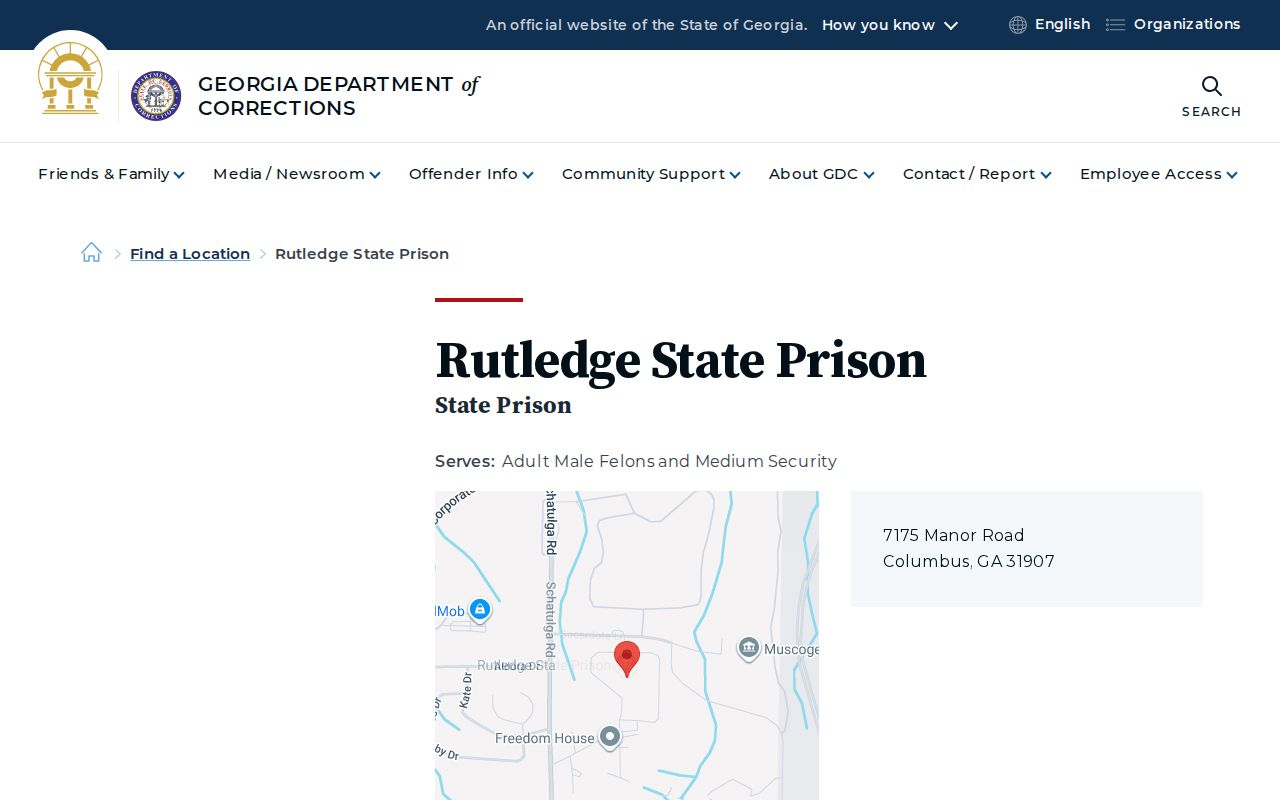
That GDC source should remain the starting point for current prison facts and state-offender routing.
Rutledge Transitional Center Transfers
Rutledge hosts Columbus Transitional Center and Charles D. Hudson Transitional Center. A move to a transitional center can occur before a sentence fully ends. Columbus Transitional Center provides a residential setting for work release and reentry preparation. The person may work or take part in community-oriented programming while still subject to GDC placement and rules.
When a search shows a transitional-center location, record the change as a transfer or placement unless GDC separately reports parole, release, or discharge. Final community release should be confirmed through the inactive offender record, release date, parole status, and DCS assignment if supervision follows. The Columbus Transitional Center release page explains that later stage in detail.
Rutledge Parole Release Records
The State Board of Pardons and Paroles decides parole. Its Inmate TPM Lookup applies while a person remains incarcerated and has a Tentative Parole Month. TPM means the month in which the Board expects to complete final review and, if appropriate, set a parole date. It is conditional. It is not proof that release occurred.
After release on parole, the Board's Parolee Search is the better public status route. DCS then handles much community supervision. The Columbus Field Office serves Muscogee County and the Chattahoochee Circuit, though the assigned office can depend on residence and case assignment. Its office is at 1334 Second Avenue, Columbus, with weekday hours from 8:00 a.m. to 4:30 p.m. and phone 706-649-0584.
Parole eligibility is not a release promise. O.C.G.A. § 42-9-45 provides the general framework, while serious-violent-felony and mandatory-service rules can alter it. O.C.G.A. § 17-10-6.1 is one key restriction. Do not apply a blanket 85 percent statement to Georgia state sentences.
Rutledge Discharge Record Fields
Reliable release confirmation combines identity, status, date, and destination. Compare the GDC ID, name, date of birth, photo if available, offense, conviction county, sentence, facility, active or inactive status, release date, parole status, and maximum-date information. A released result can still coexist with community supervision. A transfer record can show that Rutledge custody ended while state incarceration continued elsewhere.
- Inactive offender
- A person not currently incarcerated within the GDC search scope.
- Parole
- Conditional release into the community while the sentence continues.
- TPM
- A tentative parole review month, not an actual release date.
- Max-out
- Release tied to the maximum sentence term ending.
- Transfer
- Movement between custodial placements without community release.
When the web record is incomplete, request GDC verification. Georgia open-records law may provide access to public records, but lawful exemptions and redactions remain. Sealed, juvenile, medical, victim, and security information can be withheld. The Muscogee County released inmate search path also explains how state records differ from local jail, federal, and immigration systems.
Rutledge Release Date Changes
A projected state-prison date can change after sentence correction, amended judgment, new detainer, transfer, Board review, program precondition, or institutional conduct. GDC and the Parole Board may update on different schedules. Compare the latest offender record with the court sentence and parole status before relying on an older date. If a listed date is important to a planned pickup or family contact, verify it directly with GDC because a public field is not a promise of the precise exit time or release destination.
Rutledge Release Timeline Review
A Rutledge timeline begins with the Georgia sentence and GDC admission, not with the public parole tool. Record the court case, GDC ID, conviction county, sentence, and facility history. A person convicted in Muscogee County can be housed anywhere in the state system. A person housed at Rutledge can have a conviction from another county. Facility and conviction location should never be treated as the same field.
Movement to Columbus Transitional Center is a common point of confusion because Rutledge serves as its host facility. The resident may work, take part in reentry programming, and live in a less secure setting while still assigned within GDC. An active transitional-center record means placement changed. It does not establish parole, max-out, or unconditional discharge. Final release requires the later state status and date.
Parole creates a different sequence. TPM can appear while the person remains at Rutledge or another institution. It indicates a tentative month for final Board review and possible release setting. A favorable final decision can lead to GDC release and a parolee record. DCS then handles community supervision. The Board can also deny, defer, rescind, or delay an expected release, so an older TPM should not be reported as an actual exit date.
Sentence expiration can lead to release without parole. In that case, the GDC inactive record and release date are more relevant than the parolee database. Another agency hold can also affect the destination after the prison term ends. Ask GDC to verify the recorded outcome when the public view does not show whether the person entered the community or another custody system.
For a records request, include the GDC ID, full name, date of birth, former Rutledge placement, conviction county, case number, and approximate release or transfer date. Ask for the specific public release, discharge, or transfer record. Keep court, prison, parole, and supervision documents labeled by source. This prevents a tentative Board field from being mistaken for a GDC release and prevents a facility transfer from being mistaken for freedom from custody.