
Columbus Center Release Paths
GDC lists Columbus Transitional Center at 3900 Schatulga Road in Columbus. It is a minimum-security transitional center serving adult male felons. Rutledge State Prison is its host facility. Residents receive community residential services before discharge from incarceration, which makes the site a release-preparation placement rather than a county jail or fully independent residence.
A person may leave the center through parole release, sentence completion, discharge, another approved placement, or transfer back into a more secure setting. Work release or community activity does not alone prove final release. Read the GDC active or inactive status, facility, release date, and parole information before drawing that conclusion.
| Center status | Meaning and next check |
|---|---|
| Active at Columbus TC | Still in a GDC placement |
| Inactive or released | Review release date and supervision |
| Parolee record | Community release with parole conditions |
| New GDC facility | Transfer, not final discharge |
Confirm Columbus Center Release
Use GDC Find an Offender as the main public source. Accept the disclaimer and search by name, GDC ID, case number, description, sentence information, or conviction county. The form can limit results to active offenders, inactive offenders who are not currently incarcerated, or both groups. Searching both is sensible when the reported change could be release or transfer.
- Match the full name with the GDC identifier and available personal details.
- Confirm that Columbus Transitional Center was the recorded placement.
- Read the current active or inactive scope and any release-date field.
- Use Parolee Search when the person left on parole.
- Contact GDC or the center when the destination or date remains unclear.
The GDC sentence-status options include “Released In The Past 15 Days.” That is a statewide recent-release tool for GDC offenders. It is not a Muscogee County Jail release list. The “Max Prison Term Ending Next 15 Days” option can identify a near-term maximum sentence ending, but it is not an exact gate-time promise.
Center Records and Contact
Columbus Transitional Center's main phone is 706-568-2167 and its fax is 706-569-3115. Provide the person's full name, GDC ID, date of birth, former facility, and approximate release date when asking for routing. The center can address its institutional records, while GDC Inmate Records can independently verify the statewide offender record.
Columbus Transitional Center3900 Schatulga Road
Columbus, GA 31909
706-568-2167
Fax: 706-569-3115
Written GDC verification goes to Inmate Records and Information, PO Box 1529, Forsyth, GA 31029. GDC lists 404-656-4661 for offender questions and 300 Patrol Road, Forsyth, GA 31029 for general mail. Parole decisions belong to the State Board, and active community supervision belongs to DCS. Asking the right office avoids treating one agency's record as a complete account of the entire sentence.
Inside Columbus Transitional Center
GDC reports a capacity of 182. The center opened in 2005 and was renovated in 2006. New arrivals use open-bay quarters, while work-release residents may occupy two-person or four-person rooms. The mission emphasizes community residential services before discharge, self-discipline, and reentry skills. Those features mark a distinct stage between prison and final community release.
Programs include GED, workforce readiness, individual and group counseling, reentry work, Moral Reconation Therapy, the Matrix Model Early Recovery program, Fatherhood Initiative, worship services, and vocational or on-the-job activities. Program participation may support release preparation, but it does not prove that a release occurred or guarantee a parole result.
The official location page can be seen below.
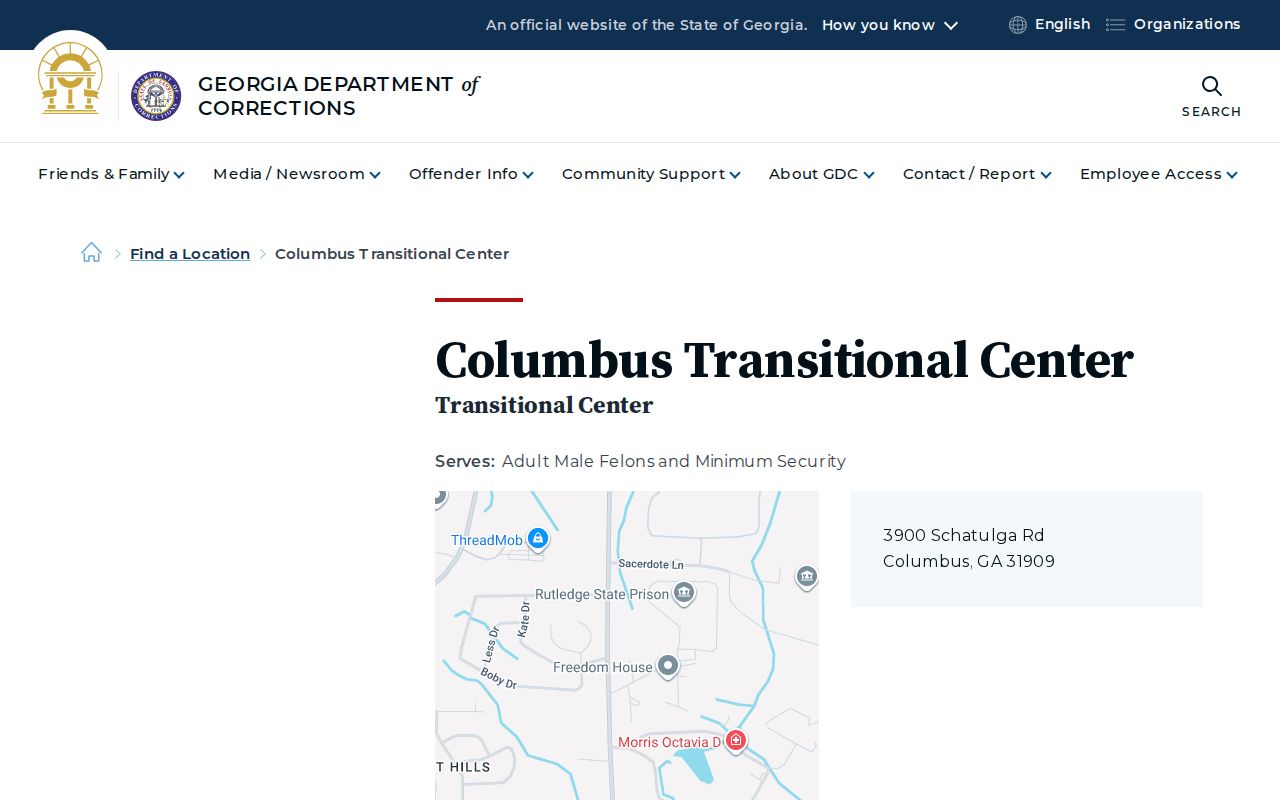
The GDC listing anchors the center's identity, capacity, custody type, contact details, and host-facility relationship.
Work Release Is Custody
Work release lets an approved resident work outside under rules while returning to the designated residential setting. The person may interact with the community and earn wages, yet remain in a correctional placement. That status differs from parole, probation, or unconditional discharge. A public observer should not infer final release merely because the person travels to work.
When the GDC record still shows Columbus Transitional Center as the active location, treat the person as placed there. When the record becomes inactive, review the actual release date and parole status. If the location changes back to Rutledge or another facility, record a transfer. The center's relationship with Rutledge State Prison makes that distinction especially important in Muscogee County.
Columbus Parole and Supervision
A resident can leave the center on parole. Parole is conditional community release from a state prison sentence after a State Board decision. The Board's Parolee Search applies after release. Its TPM Lookup applies before release and shows a Tentative Parole Month, which is the month for final review and possible setting of a parole date. TPM is not final proof of release.
DCS supervises many parolees and felony probationers. The Columbus Field Office serves Muscogee and the Chattahoochee Circuit at 1334 Second Avenue, Columbus. Published hours are Monday through Friday, 8:00 a.m. to 4:30 p.m., and the phone is 706-649-0584. Actual office assignment can depend on residence and case assignment.
A person may be out of GDC residential custody while still under parole or probation. That is not a conflict. Physical release ends confinement at the center. Supervision continues legal conditions in the community until discharge or termination.
Columbus Release Record Fields
Confirm the identity and the legal outcome together. Useful GDC fields include full name, GDC ID, photograph if available, offense, conviction county, sentence, current facility, active or inactive status, maximum-date information, release date, and parole or pardon link. A center record may also distinguish transfer from discharge. No public tool promises every field on every record.
- Transitional center
- A residential GDC setting designed to prepare a person for community release.
- Work release
- Approved work outside while correctional placement continues.
- Parole
- Conditional community release while a state sentence remains active.
- Discharge
- The recorded end of the relevant custody or sentence obligation.
- Inactive
- Not currently incarcerated in the GDC search scope.
If the online view is incomplete, ask GDC for verification. Georgia's Open Records Act supports access to public records while allowing exemptions and redaction. O.C.G.A. § 50-18-71 governs procedures and permitted costs. Medical, juvenile, victim, sealed, security, and other protected material may not be released. For comparisons with the county jail and other systems, use the Muscogee County released inmates hub.
Columbus Release Timing
A planned discharge can change after a court amendment, sentence-credit correction, new hold, Board review, transfer decision, or unmet release precondition. Public systems may update at different times. Confirm the latest GDC status before arranging transportation or treating an older date as final. The center can route a facility question, while GDC verifies the offender record and the State Board verifies parole action. None of those records should be replaced by a county jail roster result.
Columbus Center Timeline Review
A Columbus Transitional Center timeline often begins at another GDC prison. The transfer into the center marks a change in placement and release preparation, not final discharge. Record the prior facility, transfer date if available, GDC ID, sentence, conviction county, and current active status. Rutledge State Prison is the host facility, which makes accurate facility naming important when records mention both locations.
Work release can make custody appear less clear from outside. A resident may travel to approved work, earn wages, and take part in community activity while remaining subject to GDC placement and rules. Returning to the center is part of the placement. The person should be described as active in a transitional setting until GDC records a release, parole, discharge, transfer, or other status change.
Parole release creates a chain across three agencies. GDC records the end of residential custody. The State Board supplies the parole decision and parolee status. DCS handles much community supervision. The office assignment can depend on residence and case transfer, so a former Columbus placement does not prove that the Columbus Field Office is the final supervision site. Confirm the assigned office through DCS.
Maximum-term release or discharge can produce a different record. The GDC form's “Max Prison Term Ending Next 15 Days” filter can help find an approaching maximum term, and “Released In The Past 15 Days” can help find a recent state release. Neither gives a Muscogee county-jail feed or an exact departure time. A hold, sentence correction, or other agency action can also affect the final destination.
When asking for records, identify Columbus Transitional Center and the exact event sought. Request the release or transfer date, GDC status, release type, and destination if public. Provide the GDC ID, full name, date of birth, conviction county, and approximate date. Keep the response with the GDC search result, Board record, and DCS information rather than merging them into one unsourced claim. A careful summary states whether the person remained in placement, transferred, entered parole supervision, or completed the relevant sentence.