
Columbus Supervision After Release
The DCS Columbus Field Office serves the Chattahoochee Circuit and Chattahoochee, Harris, Marion, Muscogee, Talbot, and Taylor counties. Its role begins in the community, after or instead of physical confinement. DCS supervises many felony probationers and parolees. It does not operate Muscogee County Jail, decide parole, or maintain the GDC prison locator.
A person can leave custody while the sentence or supervision term continues. Parole is conditional release from a state prison sentence after a State Board decision. Probation is court-ordered supervision, often instead of or after confinement. Both can involve DCS, but the legal source differs. The parolee database supports a parole check. The sentencing court supports a probation check.
| Question | Responsible source |
|---|---|
| Was the person released from prison? | GDC offender record |
| Was parole granted? | State Board parole records |
| Was probation ordered? | Sentencing court disposition |
| Which office supervises now? | DCS assignment verification |
Verify Columbus DCS Supervision
Begin with the record that created supervision. For parole, search the State Board's parolee database and compare it with the GDC identity. For probation, search the Muscogee court case for the judgment and sentence. Then contact DCS when the public record does not identify the current assignment or when the person may have moved.
- Confirm the person by full name, date of birth, and case or GDC identifier.
- Determine whether the source says parole, probation, or another status.
- Read the court or Board record for the governing sentence and dates.
- Call the Columbus office to verify routing when appropriate.
- Use DCS open records for a public record not available through self-service tools.
Columbus DCS Office Contact
The Columbus Field Office is at 1334 Second Avenue, Columbus, GA 31901. DCS publishes Monday through Friday hours from 8:00 a.m. to 4:30 p.m. The phone is 706-649-0584 and fax is 706-383-3169. The office serves Muscogee County as part of a six-county circuit area. Actual assignment can depend on residence, transfer, and case administration.
Georgia DCS Columbus Field Office1334 Second Avenue
Columbus, GA 31901
Monday-Friday, 8:00 a.m.-4:30 p.m.
706-649-0584
Fax: 706-383-3169
DCS lists a statewide primary phone of 678-783-4337. The local number is best for ordinary office routing, while a statewide contact can help when the assigned location is unknown. Do not call the county jail to verify a parole or felony-probation office after the person has been released.
Columbus Parole Versus Probation
Parole and probation both occur in the community, but they begin differently. The State Board may parole an eligible state prisoner before the prison sentence reaches its maximum expiration. The person remains subject to parole conditions. A court orders probation as part of a sentence. It may follow jail time, accompany a split sentence, or replace confinement depending on the judgment.
| Feature | Parole | Probation |
|---|---|---|
| Decision source | State Board | Sentencing court |
| Custody link | Release from state prison | Court sentence |
| Public check | Parolee Search | Court judgment |
| Community agency | DCS in many cases | DCS for many felony cases |
| End record | Parole discharge | Court or supervision termination |
A jail release caused by bond is neither parole nor probation unless the court record separately says so. A transfer to GDC is not community supervision. Keeping these distinctions clear prevents the office from being used as a substitute for the jail, court, or prison record.
Columbus DCS Records Requests
The DCS contact page says records requests are subject to the Georgia Open Records Act and may result in billing. Questions for the DCS Open Records Custodian can go to 404-463-2072. A request should identify the person, case or GDC number, county, type of supervision, approximate dates, and the specific public record sought.
Ask for a defined item, such as public confirmation of supervision status or office assignment, rather than all material in a case file. Some supervision data may be limited. Medical information, protected victim information, sealed records, security material, and other exempt content can be withheld or redacted. A court judgment or Board result may offer faster public confirmation of the legal source.
- Absconder
- A supervision status involving alleged failure to remain in contact, which requires agency confirmation.
- Violation
- An alleged breach of a supervision condition, not a final finding by itself.
- Warrant
- A court or agency order whose active status must be checked at its source.
- Discharge
- The recorded end of the supervision obligation.
Muscogee Warrants and Status
No Muscogee-specific public DCS absconder list was found in the official sources reviewed. The local eCourt Smart Search supports warrant criteria, including warrant type, status, and issued-date range. That court route can reveal a warrant record, but DCS or the issuing authority must explain a supervision designation.
Do not treat an old warrant entry as current without reading its status. Do not infer absconding merely because a person does not answer or no longer appears at an address. Public records can lag, and office assignments can transfer. For a safety or court-compliance issue, contact the responsible agency directly rather than relying on a third-party summary.
The local office source is shown below.
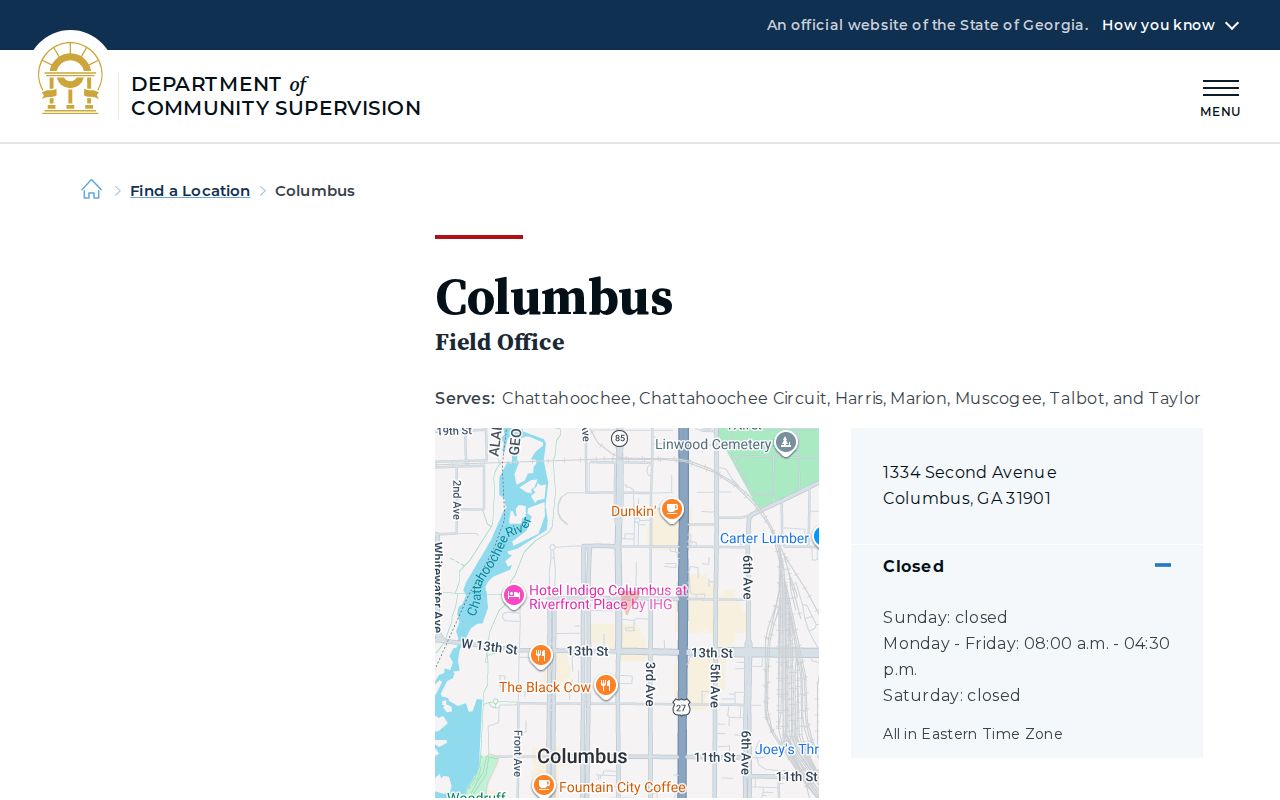
The DCS location page confirms the service area, address, hours, phone, and fax used for Muscogee supervision routing.
Columbus Supervision Discharge
Discharge marks the end of the relevant supervision duty. A person can have left jail or prison long before discharge. For parole, the State Board record is central. For probation, the court and DCS record can show termination or completion. A person may also have more than one case, so one completed term does not resolve every possible obligation.
Use the Georgia Parole Search for parole status and tentative timing. Use GDC Find an Offender for state incarceration and release fields. Use Muscogee eCourt for local dispositions and warrants. The Muscogee County released inmate search adds county jail, VINE, BOP, and ICE paths.
The field office does not calculate a county jail release date. It does not replace the Board's TPM or final parole action. It is the local destination for supervision service and verification after the proper release record has been found.
Prepare a Columbus DCS Call
Have the person's full legal name, date of birth, case number or GDC ID, conviction county, release date, and known supervision type before calling. State the narrow question first, such as whether Columbus is the proper office or where a public records request should go. Do not send medical data or other sensitive details through an unverified channel. If the office cannot disclose a status by phone, ask for the correct public form or records custodian rather than assuming the absence of an answer means supervision ended.
Columbus Supervision Record Sequence
A Muscogee post-release record often starts with a court or prison event. A person who receives felony probation in Superior Court may report to DCS without ever serving a state-prison term. Someone paroled from Rutledge or another GDC facility reaches DCS through a State Board release. A person who merely posts bond from Muscogee County Jail may have no DCS supervision at all unless a separate sentence or existing case creates it. Confirm the legal source before calling the field office.
For probation, read the judgment for the length and basic structure of the sentence. A split sentence can combine confinement and probation. A revocation or modification can later change that structure. For parole, use GDC to confirm prison release and the Board database to confirm parole. DCS then becomes the source for the current supervision assignment. These systems may show different dates because they record different events.
Conditions and alleged violations are case-specific. Public descriptions should stay at a high level. Common supervision duties can include reporting, obeying court or Board instructions, and complying with approved plans, but the actual order controls. An allegation does not prove a violation. A court, Board, or authorized agency determines the result through the applicable process. Public Smart Search warrant criteria may help locate an issued warrant, yet the issuing authority remains the source for whether it is active.
Completion also follows the original legal source. A parole discharge comes through the state parole process. Probation termination or completion is tied to the court and supervision record. A person may finish one case while another remains active. Ask about the specific case number and supervision type. Broad statements such as “off supervision” can be wrong when several matters share the same name.
When records are requested, separate public confirmation from protected case-management information. DCS may provide a public record while withholding confidential or exempt material. Supply only enough personal data to locate the right file through the official channel. Keep a copy of the request, any fee estimate, and the agency response. If the question belongs to the clerk, Board, GDC, or sheriff, follow the referral. The Columbus office is most useful when the issue truly concerns community supervision or local office assignment.