
Muscogee Scheduled Versus Actual Release
A projected release date is an estimate or scheduled point based on the sentence and the agency's current record. Actual release is the event when the person leaves that custody. The two may differ. A pretrial detainee at Muscogee County Jail usually has no computed GDC release date because bond, dismissal, a court order, transfer, or case disposition controls the next step. A sentenced Georgia prisoner may have a maximum-term date in GDC records and a separate parole timeline.
A jail booking can also end without community release. Transfer to GDC, another jail, BOP, ICE, or another agency closes one custody entry while confinement continues elsewhere. Identify the holding system before reading any date. For Muscogee jail custody, use the court order, bond status, Jail Search, and sheriff records. For state prison custody, use GDC and the Parole Board.
Find Muscogee Projected Release Dates
The correct lookup depends on custody. GDC Find an Offender is the state source for a person serving a Georgia sentence. It can be searched by name, description, GDC ID, case number, sentence status, primary offense, and conviction county. Muscogee County appears in the conviction-county filter. The search scope separates active inmates from inactive people who are not currently incarcerated.
- Confirm whether the person is in Muscogee County Jail, a GDC facility, or another system.
- For jail custody, check the Muscogee eCourt portal, bond and case orders, then call the jail records route.
- For GDC custody, accept the offender-search disclaimer and search active records by name or ID.
- Review release-date, maximum-term, facility, sentence, and parole-status information shown for that record.
- Check the Board TPM tool only if parole review applies, then confirm changes with the responsible agency.
The county jail is at 700 E. 10th Street, Columbus, and its information line is 706-653-4258. A full booking or release entry can be requested from the sheriff when the public portal lacks the needed date. The Muscogee County release search explains that county records path in full.
Muscogee Release Date Calculations
Georgia does not support a blanket claim that every state prisoner serves a fixed percentage. For many parole-eligible felony sentences, O.C.G.A. § 42-9-45 provides eligibility after nine months or one-third of the sentence, whichever is greater, subject to exceptions. Eligibility only allows consideration. It is not a release date, and the Board says few people are granted parole at the first eligibility point.
Serious violent felony rules can require far more time and restrict parole, probation, or suspension. O.C.G.A. § 17-10-6.1 is a key source for those sentences. Recidivist and life-sentence provisions can also change eligibility. The sentence, offense, and court order must therefore be read before applying a general formula.
The Board's Parole Decision Guidelines describe a TPM and a performance incentive credit date, or PIC date. The gap between them is the maximum amount the TPM may move earlier for good conduct. Poor performance can add time without the same stated cap. This is a parole scheduling method, not a guaranteed bank of days deducted from every Muscogee sentence.
Why Muscogee Release Dates Change
A date can move because the legal sentence, custody destination, or parole decision changed. A detainer is a request or hold from another agency. It can prevent community release even when the Muscogee booking or one sentence ends. Data also move at different speeds. Court, jail, VINE, GDC, and Board records may not update at the same moment.
| Factor | Possible effect | Best confirmation |
|---|---|---|
| Amended sentence or jail credit | Moves the computed term | Court order and records office |
| Detainer, warrant, or pickup | Transfers custody instead of community release | Jail, court, and receiving agency |
| Parole decision | Grants, defers, delays, or rescinds timing | State Parole Board |
| Conduct or program condition | May advance or delay the TPM | Board and GDC |
| Transfer to transitional center | Changes facility, not final custody status | GDC offender record |
Record restriction or sealing can change what the public sees, but it does not itself alter the sentence or custody event. When a result disappears, do not infer that the date moved. Ask the originating custodian.
Confirm Muscogee Actual Release
A projected date should be checked again near the expected event. For county jail custody, use Jail Search, the court disposition, and Muscogee VINE. The sheriff's VINE page supports email, text, and phone custody-change alerts. Phone registration uses a four-digit PIN, and callback attempts may continue within the next 24 hours until that PIN is entered. Detailed registration steps are on the Muscogee VINELink check page.
For GDC custody, review the offender record and contact GDC when the date is important or unclear. GDC directs written verification to Inmate Records and Information, PO Box 1529, Forsyth, GA 31029. A past release date and inactive status can confirm departure from GDC custody, but another hold or community supervision may still follow.
Note: VINE is a custody-status signal, while the court, jail, GDC, and Board records explain the authority and type of release.
Muscogee Fifteen-Day Release Filters
Georgia provides two unusually specific sentence-status filters. GDC Find an Offender includes “Max Prison Term Ending Next 15 Days” and “Released In The Past 15 Days.” The first can narrow state prisoners nearing a maximum-term end. The second can locate very recent GDC releases. Neither is a Muscogee County Jail release feed. Both cover the Georgia corrections system.
Use these filters with Muscogee as conviction county when the person was sentenced there, or search by the person's GDC ID. A conviction-county match does not prove the person is held in Columbus. Likewise, a person housed at Rutledge State Prison or Columbus Transitional Center may have been convicted elsewhere. Name, ID, facility, offense, and status should be matched together.
The GDC query form displays the state sentence filters after its disclaimer.
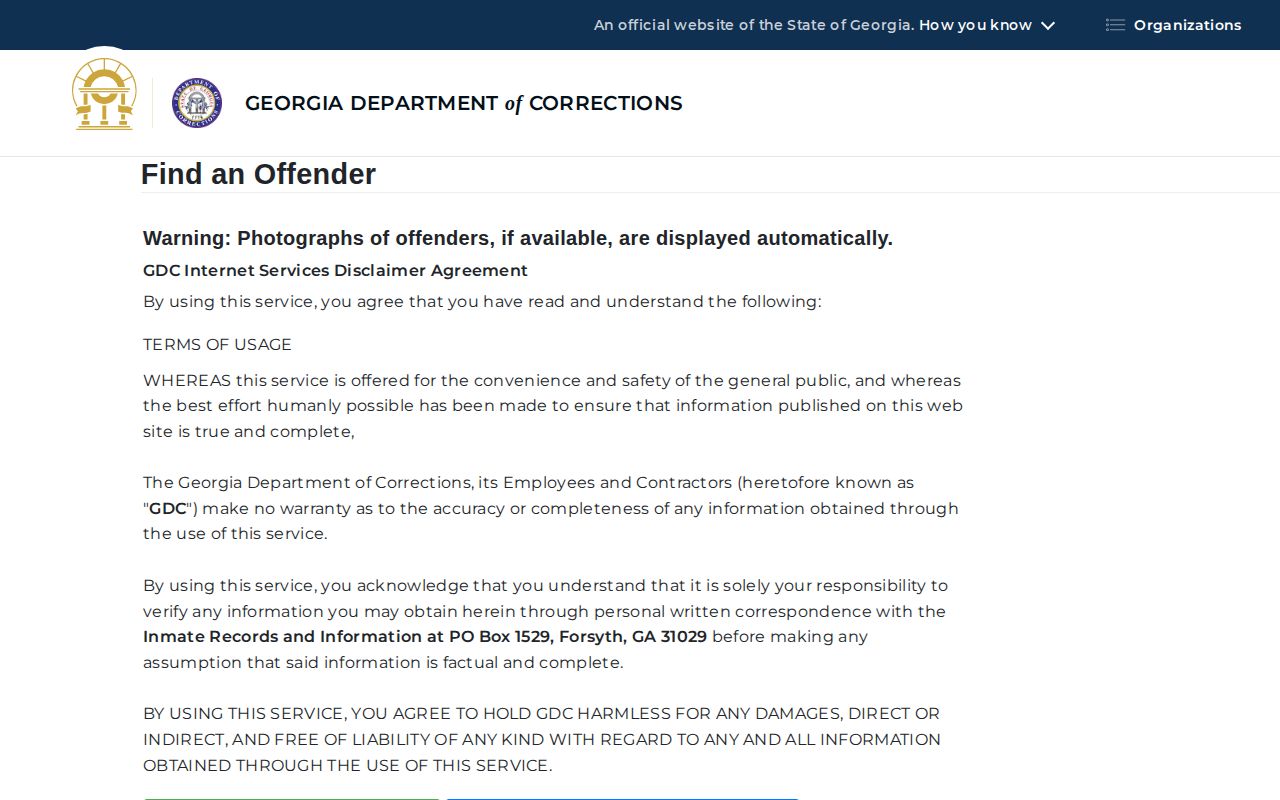
The form's active, inactive, upcoming-term, and recent-release choices keep state discharge research separate from the local jail roster.
Muscogee Tentative Parole Month
A Tentative Parole Month is not the same as a maximum release date. The Board TPM page says it is the month when final review will occur and, if appropriate, a parole date will be set. The public lookup accepts a six-digit inmate number, GDC ID, or personal data. A TPM can be conditioned on conduct or completion of a program.
Possible outcomes include a finalized parole release, denial or deferral, delay, rescission, or continued custody until sentence expiration. The result belongs to a state-prison case. A person merely awaiting trial in Muscogee County Jail generally has no TPM because the Parole Board is not deciding a pretrial bond release.
The official TPM explanation shows the limits of the field.
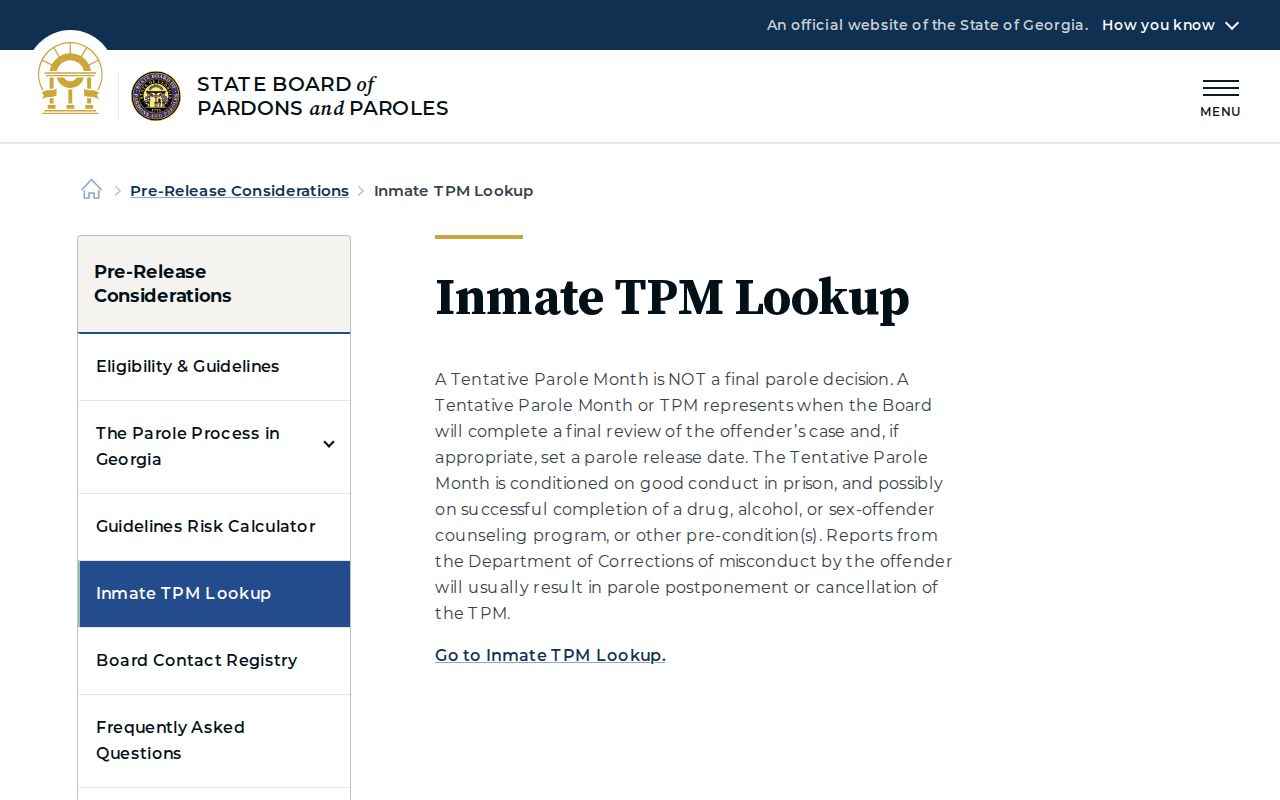
The Board's explanation is the source for interpreting the month as tentative rather than guaranteed.
Muscogee Custody Release Timelines
County jail, state prison, and transitional-center timelines must remain separate. A pretrial Muscogee jail detainee may leave after bond is posted, a court changes the case, a warrant is recalled, or another order issues. None of those events creates a GDC sentence calculation. A sentenced county-jail inmate may have jail credit reflected in the court and jail record. When another agency has a hold, the end of the local booking can lead to pickup instead of community release.
A person transferred to Muscogee County Correctional Institution follows a state-sentence or county-offender path that may appear in GDC. Rutledge State Prison is a GDC prison. Columbus Transitional Center provides residential preparation before discharge, but placement there is still a corrections setting. Moving from Rutledge to the center changes location and phase of custody. It does not prove final release. GDC inactive status, a finalized parole record, or an agency discharge entry is needed.
Federal and immigration dates stand apart. A BOP result can show a past federal release date and no current facility, while ICE ODLS focuses on current detention. Neither computes a Muscogee jail release date. When systems overlap, build a timeline from the court order, booking end, transfer, new facility entry, and final release. That sequence prevents one agency's exit date from being mistaken for freedom from all custody.
Muscogee Release Date Records
The record requested should match the date in dispute. For a county booking, ask the sheriff for the release date and time, release type, booking number, charges, and transfer destination if one was recorded. Pair that response with the court order. For a state sentence, ask GDC about the offender information or why a record does or does not appear online. GDC lists “Information about a specific Offender/Transfers/County Jail Pick-up” as a contact category.
A parole question belongs with the State Board. Its main public tools separate the TPM lookup for a person still under review from Parolee Search for someone already released on parole. DCS is the community-supervision source after assignment. This division matters because a TPM date, a prison release date, a DCS reporting date, and a final discharge date can all differ while each remains correct for its own event.
For a Muscogee jail detainee, no public projected-date field was found in the reviewed official sources. Do not create one by subtracting days from a charge or bond entry. The court and jail must apply sentence credit, orders, holds, and release processing. A calculation made without those records can miss the very event that changes the date.
Note: The most recent agency record should be checked again because an older projected date may have been superseded by a later order or Board action.
Verify Muscogee State Release Dates
GDC directs questions about a specific offender, transfer, or county-jail pickup through the matching category on its contact page. Its public offender-search disclaimer also gives a written verification route: Inmate Records and Information, PO Box 1529, Forsyth, GA 31029. Written verification is useful when an online date is missing, appears stale, or conflicts with a court or parole record. Include the person's full name and GDC ID when known.
The source of the date still matters. GDC verifies state custody and sentence information. The State Board verifies a tentative parole month or parole decision. Muscogee County Jail and the court verify a local booking, bond order, sentence credit, or release entry. DCS verifies community supervision after release. Asking one office to certify another agency's date can produce an incomplete answer, even when both records concern the same person.