
MCCI Offender Release Paths
The Georgia Department of Corrections listing places Muscogee County Correctional Institution, also called Muscogee County Prison, at 7175 Sacerdote Lane in Columbus. It is a medium-security county correctional institution for adult male felons. Columbus Consolidated Government operates the local institution within Georgia's county-correctional framework. It houses both state and county offenders and provides work details that support county government.
A person leaving MCCI should first be traced in GDC records. An inactive offender result may show that the person is no longer incarcerated. A parole release can also lead to the State Board parolee database and DCS supervision. Transfer to another prison, transitional center, or jail is not community release. The destination and status fields matter as much as the end date.
| Recorded outcome | Best confirmation |
|---|---|
| GDC discharge | Inactive offender status and release date |
| Parole release | GDC, Parolee Search, and DCS |
| Facility transfer | Active GDC location |
| County sentence issue | Facility and sentencing-court records |
Confirm MCCI Release Status
Open GDC Find an Offender and accept its disclaimer. Search by name, GDC ID, case number, personal description, offense, or conviction county. Set the scope to “Only Inactive Offenders (Not Currently Incarcerated)” if release has occurred. Choose both active and inactive when transfer remains possible. The conviction county list includes Muscogee County, and the sentence-status list includes “Released In The Past 15 Days.” That recent-release filter covers GDC offenders, not Muscogee County Jail bookings.
- Match the person by name, identifier, conviction county, and any available photograph.
- Read the status, current location, sentence, offense, and release fields.
- Follow the parole or pardon status route when parole applies.
- Check DCS for current community supervision after release.
- Ask GDC or MCCI to verify an incomplete or unclear result.
MCCI Records and Contact
MCCI's main phone is 706-641-5800 and its fax is 706-641-5840. Ask which office holds the specific release, transfer, or discharge document before sending a broad request. Give the full name, date of birth, GDC ID if known, conviction county, sentence, and approximate release date. A focused request helps distinguish the institutional record from a court judgment or supervision record.
Muscogee County Correctional Institution7175 Sacerdote Lane
Columbus, GA 31908
706-641-5800
Fax: 706-641-5840
GDC directs written offender verification to Inmate Records and Information, PO Box 1529, Forsyth, GA 31029. Its main contact route lists 404-656-4661 for offender questions and 300 Patrol Road, Forsyth, GA 31029 for mail. The contact categories include questions about a specific offender, transfers, and county-jail pickup. DCS has a separate records custodian for supervision information, while the State Board controls parole decisions.
Inside Muscogee County Prison
GDC says MCCI was constructed and opened in 1997 with a capacity of 528. Its stated mission includes confining state and county offenders and providing labor for Muscogee County Government. The Columbus government prison page says the move to the current facility was completed in March 1997. It reports that about 425 people are dispatched to outside work details each day, while around 150 remain inside for facility services and city-property maintenance.
The local source also describes GED and on-the-job training opportunities. It reports a state subsidy of $20 per state inmate per day. These facts explain the institution's county-work mission and its mix of state and county offenders. They do not predict an individual's release date or establish eligibility for any program.
The official GDC location page shows the record source used for this facility.
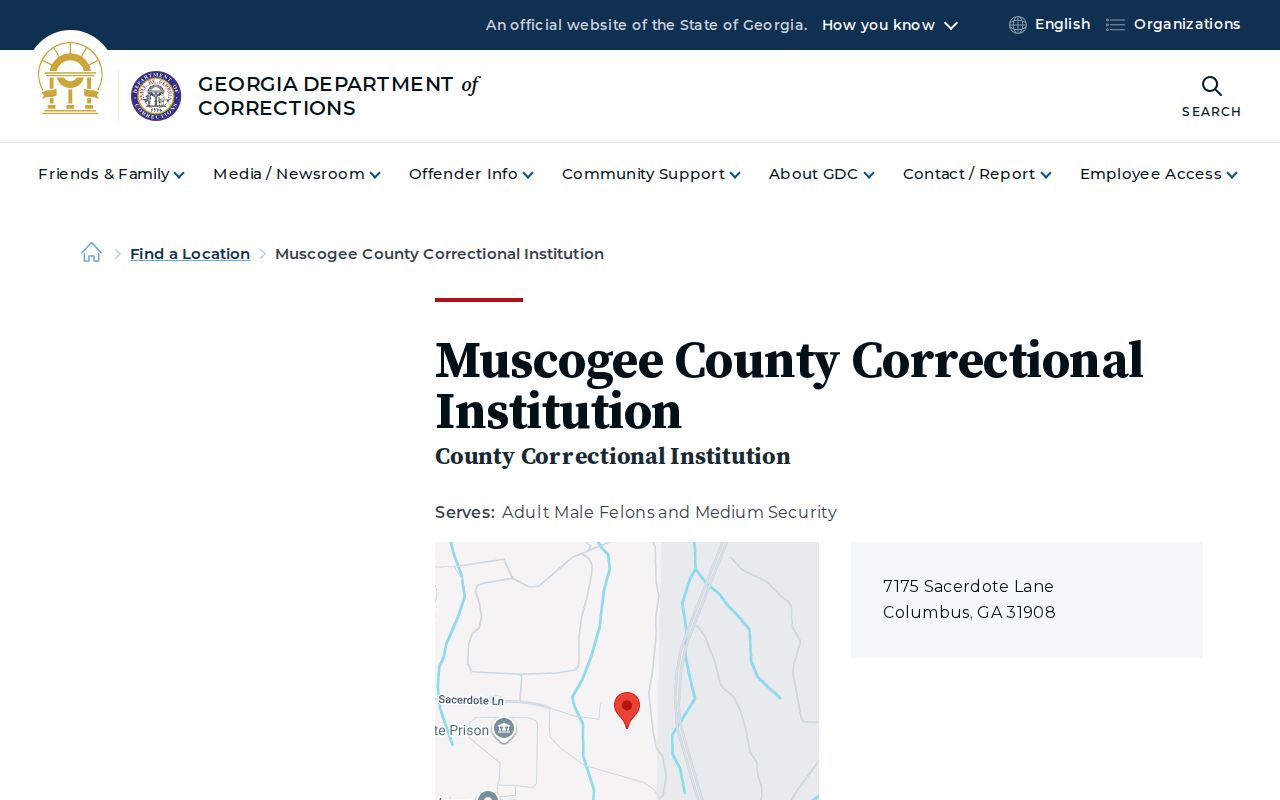
The listing confirms that this institution belongs on the state-offender search path even though Columbus Consolidated Government operates it locally.
Columbus Custody Systems Differ
Muscogee County Correctional Institution, Muscogee County Jail, Rutledge State Prison, and Columbus Transitional Center are all in Columbus. They are not interchangeable. The county jail handles local bookings and pretrial custody. MCCI houses state and county offenders in a work-oriented county institution. Rutledge is a GDC state prison. Columbus Transitional Center is a minimum-security residential reentry setting before discharge.
The correct search changes with the site. Jail Search and VINE lead for a county-jail booking. GDC leads for MCCI, Rutledge, and the transitional center. A court disposition explains the sentence. The Parole Board and DCS explain community supervision. If a local jail record ends because GDC picked up the person, the result is a transfer, not release to the community. The Muscogee County released inmates hub lays out the full cross-system sequence.
MCCI Parole and Discharge
Discharge and parole describe different results. A discharge generally records the end of the relevant sentence or custody obligation. Parole allows an eligible state prisoner to serve part of a sentence in the community under conditions set by the State Board. A person can therefore be released from MCCI and still remain subject to a state sentence and DCS supervision.
The Board's TPM, or Tentative Parole Month, is not a final release date. It marks a month for final review and possible parole setting. Georgia law and Board rules can change eligibility based on the sentence and offense. O.C.G.A. § 42-9-45 contains the main parole-eligibility framework, while O.C.G.A. § 17-10-6.1 creates serious-violent-felony restrictions. Georgia does not have a universal 85 percent rule for all state sentences.
Confirm actual release in GDC records. Then use the Georgia parole systems and the Columbus DCS office. The parolee database applies after parole release; TPM applies while the person remains imprisoned and under review.
MCCI Release Record Fields
A useful release verification should identify the correct person and explain the change in custody. Request or compare the GDC ID, full name, date of birth, facility, offense, conviction county, sentence, status, release date, release type, parole status, and destination when available. Online records do not promise that every field appears for every offender. GDC expressly calls for independent verification when accuracy matters.
- Active
- The person is currently incarcerated within the GDC search scope.
- Inactive
- The person is not currently incarcerated in that scope, which still requires reading the release details.
- Parole
- Conditional community release while a state sentence continues.
- Discharge
- The recorded end of the applicable custody or sentence obligation.
- Transfer
- Movement to another custodial site rather than release into the community.
Georgia's Open Records Act can provide a records route when the public view is incomplete, subject to lawful redactions and fees. O.C.G.A. § 50-18-71 permits copy charges up to ten cents per letter or legal page plus allowed production costs. Juvenile, sealed, medical, victim, and other protected information can remain withheld or redacted.
MCCI Release Timeline Review
An MCCI custody timeline can start in Muscogee court, move through the county jail, and continue into the county correctional institution under a state or county sentence. Record each event separately. The court judgment establishes the sentence. A jail transfer entry can show when the local booking stay ended. GDC identifies the correctional placement and later active or inactive status. Parole and DCS records apply only when the sentence follows those paths.
A person can leave MCCI through transfer rather than release. An active GDC record at a new location means incarceration continued. An inactive result can indicate that GDC no longer lists current incarceration, but the individual record should still be read for release date and parole status. A person released on parole may remain under a state sentence in the community. Someone who reaches sentence expiration may have no parolee record.
Date differences can arise from an amended judgment, jail-credit correction, GDC sentence calculation, detainer, pickup by another agency, or a later system update. Compare the conviction county, case number, GDC ID, sentence, facility history, and exact query date. A name-only result is not enough to connect the records. Muscogee County as conviction county also does not prove that the person remained in Columbus for the whole sentence.
When a formal release record is needed, ask for the narrow event and fields. Identify MCCI, the approximate date, GDC ID, and court case. Request the recorded release or transfer date, status, destination if public, and discharge or parole information held by that office. The sentencing court, GDC, State Board, and DCS each control different records, so one broad request sent to the wrong office can miss the key document.
Preserve the exact status language in any summary. “Released from MCCI” should not be used when the record shows transfer to another correctional site. “Inactive in GDC” should not be expanded into a claim that every supervision term ended. A precise statement identifies the agency, facility, date, and next status supported by the official source.