
Georgia Parole Search Paths
The State Board of Pardons and Paroles is Georgia's parole decision authority. Its public routes serve two distinct questions. Parolee Search helps confirm information about someone already released on parole. Inmate TPM Lookup provides tentative parole timing for an incarcerated person under Board review. DCS, not the Board, handles much day-to-day community supervision after release.
A Muscogee County Jail bond or time-served release usually has nothing to do with parole. Parole applies to a state prison sentence. Start with GDC when custody type is uncertain. If GDC shows a state offender and the person may have left on parole, move to the parolee database. If the person remains imprisoned and the question is when parole might occur, use TPM.
| Question | Correct Georgia route |
|---|---|
| Already released on parole? | Parolee Search |
| Tentative future parole month? | Inmate TPM Lookup |
| Still in GDC custody? | GDC Find an Offender |
| Current supervision office? | DCS and assigned field office |
Search Georgia Parolees
The direct Parolee Search is designed for people already on parole. The public application accepts first name, last name, race, and any additional criteria shown by the live form. Begin with accurate spelling and then broaden if a narrow query yields no result. Compare the returned identity and status with the GDC offender record before concluding that a similarly named person is the intended match.
- Confirm that the person served or is serving a Georgia state sentence.
- Search the parolee database with the strongest known identity fields.
- Compare the result with GDC ID, name, conviction, and release context.
- Read the parole status without treating it as a complete court file.
- Contact the Board or DCS when the public result needs verification.
Georgia TPM Lookup
The Inmate TPM Lookup information page explains Tentative Parole Month. A TPM is the month in which the Board expects to complete final review and, if appropriate, set a parole release date. It is not a final parole decision. Good conduct and completion of programs or other Board preconditions can matter before actual release.
The lookup can use a six-digit inmate number, GDC ID number, or personal data as presented by the application. If the record shows a TPM, report it as tentative. Do not convert the month into a specific day. A Board denial, delay, rescission, reconsideration, disciplinary issue, detainer, sentence change, or unmet precondition can alter the path.
- TPM
- Tentative Parole Month for final review and possible release setting.
- Eligibility
- The point at which parole may be considered, not granted.
- Parole
- Conditional community release while a sentence continues.
- Discharge
- The recorded end of the relevant sentence or supervision duty.
Georgia Parole Decision Process
The Parole Process in Georgia says most parole-eligible inmates are statutorily eligible after serving one-third of a prison sentence, while few receive parole at initial eligibility. Eligible people are automatically considered. Eligibility is therefore a review threshold, not a promised release date.
O.C.G.A. § 42-9-45 supplies the main eligibility framework. Serious-violent-felony rules in O.C.G.A. § 17-10-6.1, recidivist provisions, life sentences, mandatory minimums, and other restrictions can change the result. Georgia does not apply one blanket 85 percent rule to all state sentences. Board rule 475-3-.05 also preserves Board discretion and addresses consideration and reconsideration.
The official parole-process presentation is shown below.
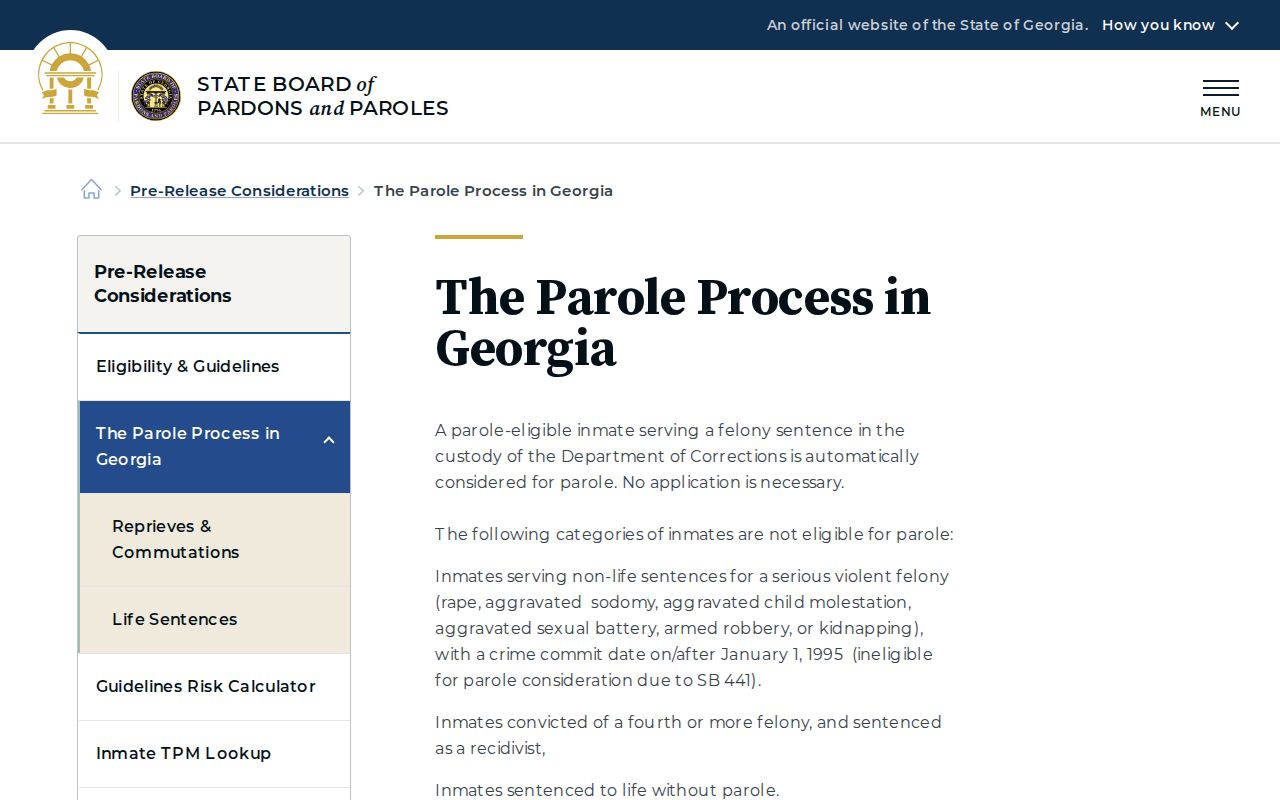
The Board source explains why statutory eligibility, tentative scheduling, and final parole release must be kept separate.
Georgia Parole Date Changes
The Board's decision guidelines describe a TPM and a PIC date when parole is tentatively scheduled. The time between those dates is the maximum amount by which good conduct can advance the TPM under that framework. The Board also says poor performance can add time without the same stated limit. This is not a simple guaranteed credit.
A release plan can change after institutional conduct, program completion or failure, a new detainer, amended sentence, court action, or Board review. GDC and Board systems may update at different times. Confirm actual release through the GDC status and parolee record. For a person still incarcerated, describe TPM only as tentative.
| Public field | What it establishes |
|---|---|
| TPM | Expected month for final review |
| GDC release date | State custody release field |
| Parolee result | Post-release parole information |
| DCS office | Community-supervision contact |
Muscogee Parole Supervision
A person released on parole to Muscogee County may report through DCS. The Columbus Field Office serves Muscogee, Chattahoochee, Harris, Marion, Talbot, and Taylor counties and the Chattahoochee Circuit. Its address is 1334 Second Avenue, Columbus, GA 31901. Published hours are Monday through Friday, 8:00 a.m. to 4:30 p.m. The phone is 706-649-0584.
The assigned office can depend on residence and case assignment. Do not use the field-office location as proof that every Muscogee release reports there. DCS can address supervision routing, while the Board controls parole decisions. A person can be out of prison but still under parole conditions. That is a release from physical custody, not a full sentence discharge.
The Columbus supervision destination page explains DCS records, office contacts, and the difference between parole and probation.
Georgia Parole Record Verification
The State Board lists 404-656-4661 as a main phone. When asking about a record, provide the full name, date of birth, GDC ID or inmate number, conviction county, prison, and approximate release or TPM period. Avoid asking the Board to certify a county-jail release, because that record belongs to the sheriff and court systems.
State Board of Pardons and ParolesParolee Database and Inmate TPM Lookup
Main phone: 404-656-4661
pap.georgia.gov
Use GDC for prison location and release fields. Use the Board for parole decisions and parolee information. Use DCS for current supervision and office assignment. Court records can clarify the sentence, while the Muscogee County released inmate search supplies the local jail, VINE, federal, and immigration alternatives.
Public information can be incomplete or delayed. Georgia open-records law allows access to public agency records subject to lawful redactions, fees, and exemptions. Medical, victim, juvenile, sealed, and security material may remain unavailable. A narrow request tied to a known person and event is the most useful fallback.
Muscogee Parole Search Limits
A parole record does not establish that every local charge ended, that no warrant exists, or that a person has no separate probation case. Muscogee eCourt Smart Search can show cases, judgments, and warrants tied to the local courts. Compare those records only to explain the legal path, not to replace the Board's parole status. Likewise, absence from the county jail roster says nothing definite about state parole. Each system answers a narrow custody or supervision question, and the originating agency remains the source for correction.
Muscogee Parole Record Sequence
A complete parole check begins before the Board tools. Confirm the person in GDC Find an Offender and note the GDC ID, conviction county, facility, sentence, and current custody status. For someone convicted in Muscogee County, the conviction-county filter can narrow the state search. If the person remains active at Rutledge, Muscogee County Correctional Institution, Columbus Transitional Center, or another state facility, TPM may answer a tentative timing question. If GDC shows release and parole is reported, move to Parolee Search.
The records should tell a coherent sequence. A TPM can appear while the person remains incarcerated. A final parole action can lead to a GDC release date. The parolee database can then reflect community parole, and DCS can identify the supervision office. These updates may not post at the same moment. A changed GDC status without a parolee result could mean data lag, sentence expiration, discharge, a different release type, or a query mismatch. It should not be forced into a parole conclusion.
Local court records add sentence context but do not replace the Board. Muscogee Smart Search can help locate the criminal case, judgment, sentence, and later warrant entries. A Superior Court sentence may show the term that sent the person to GDC. The Board then applies Georgia parole law and its own decision process. The court does not publish the TPM, and the Board does not serve as the county clerk's certified judgment source.
Post-release questions also require care. DCS office assignment may change when a parolee moves or a case transfers. The Columbus Field Office serves a multi-county area, not only Muscogee County. Confirm the assigned office through DCS rather than assuming that a conviction or former prison location fixes the supervision site. Discharge from parole is another separate event. Release from prison starts community parole, while discharge ends the parole obligation when the official record says it has ended.
Keep the identifiers and dates from each source. If one system conflicts with another, contact the agency responsible for that field: GDC for custody and release data, the Board for TPM and parole decisions, DCS for active supervision, and the court for the judgment. This division produces a more reliable answer than treating any single search result as the whole state sentence record.