
BOP Federal Release Scope
The BOP Inmate Locator covers federal inmates incarcerated from 1982 to the present. It searches Bureau of Prisons records. A Muscogee County resident can appear there after a federal conviction, but a local Columbus arrest does not automatically create a BOP record. The county jail, GDC, ICE, and BOP systems serve different legal custody.
BOP can display “Released” or “Not in BOP Custody.” When no facility is listed and the release date is in the past, BOP explains that the person is no longer in Bureau custody. That statement has limits. The person may be on federal supervised release, in another law-enforcement system, subject to a state case, or held by a different agency.
| Custody question | Correct source |
|---|---|
| Sentenced federal inmate | BOP Inmate Locator |
| Muscogee jail booking | eCourt Jail Search and sheriff records |
| Georgia state offender | GDC Find an Offender |
| Immigration detention | ICE ODLS |
| Federal supervised release | Federal court and U.S. Probation |
Search BOP Inmate Records
BOP offers a number search and a name search. Number search is strongest when the BOP Register Number, DCDC Number, FBI Number, or INS Number is known and accepted by the form. Name search uses first, middle, and last name with race, sex, and age filters as offered. Begin with the most specific identifier, then compare all visible identity details.
- Open the official locator and choose number or name search.
- Enter the identifier exactly, or use the full legal name.
- Compare race, sex, age, register number, and other available cues.
- Read the current facility or released status and date.
- Check another system when BOP reports no current custody.
Read BOP Release Results
The BOP About Federal Inmate Records page explains its release language. If a listed release date is in the past and no facility appears, release occurred on that date and the person is no longer in BOP custody. A result can also identify a current institution or report another status. Record the exact wording rather than shortening all outcomes to “free.”
- Released
- No longer in BOP custody as of the federal record's release information.
- Not in BOP Custody
- Outside Bureau custody, with another status still possible.
- Facility
- The current BOP institution listed for a person in Bureau custody.
- Release date
- The date shown for the relevant federal custody release.
- Supervised release
- Federal court supervision after imprisonment, separate from BOP confinement.
A projected future date can change after sentence computation, court action, credit correction, disciplinary decision, or another legal development. Verify a date that matters with BOP or the relevant federal record. The public locator is a navigation and status tool, not a substitute for a certified court judgment.
Muscogee Federal Custody Transfers
A person can leave Muscogee County Jail through federal agency pickup. The county release entry may call that a transfer rather than community release. A federal pretrial detainee can be held under U.S. Marshals authority without appearing as a sentenced BOP inmate. There is no universal public USMS locator that works like BOP. Federal court records and the holding facility may be needed before a BOP commitment exists.
When a local record points to federal custody, preserve the booking number, local case, release or transfer date, and named receiving agency. Search BOP, but do not treat a missing result as proof that the transfer did not occur. Timing and the difference between pretrial and sentenced custody matter. The BOP locator becomes most useful once a person is in Bureau records.
The official locator is shown below.
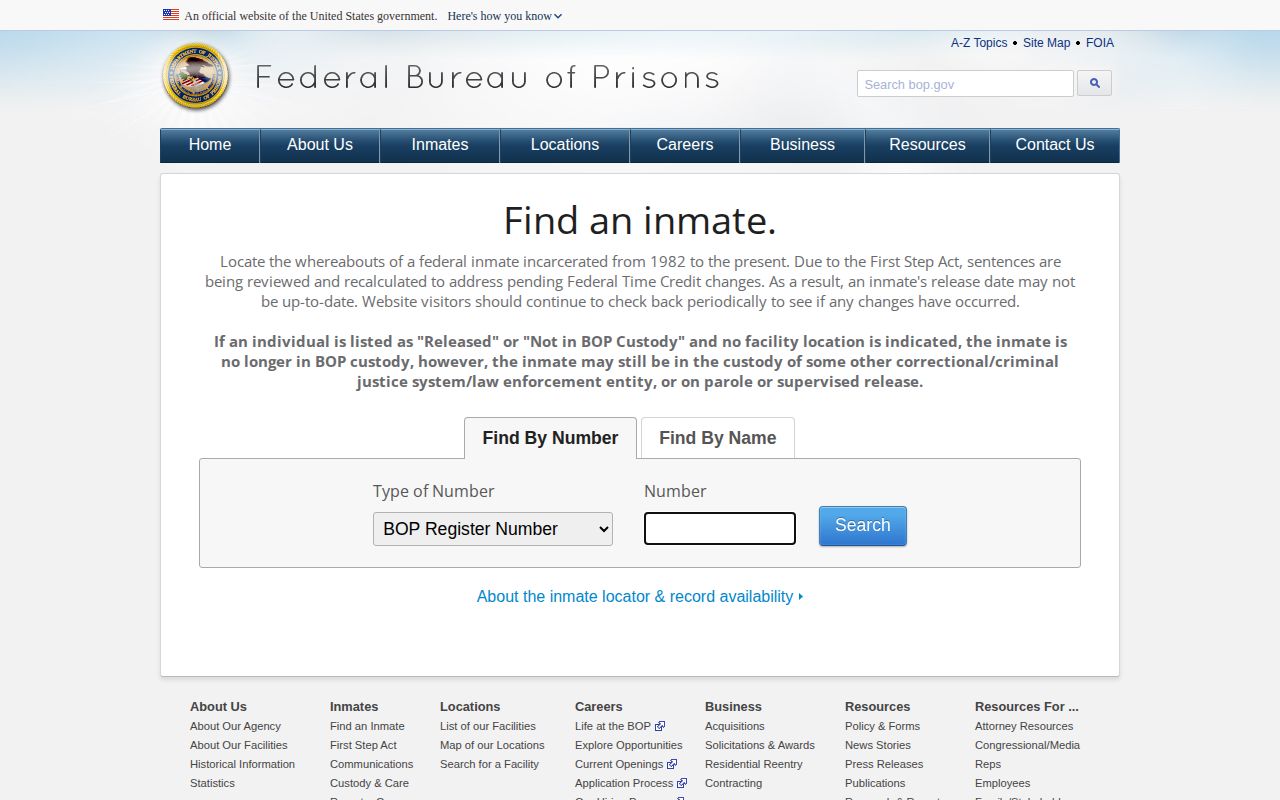
The federal form provides number and name routes that should be matched against the local transfer information.
BOP Release Record Limits
BOP's public coverage begins with federal inmates from 1982 forward. Older records may require archival research. The locator does not supply a Muscogee booking photo, local bond reason, Georgia parole status, or county court disposition. It also does not prove that a person has no other custody or supervision after leaving BOP.
Federal release can be followed by supervised release under a federal court. That is not Georgia parole and is not handled by the Columbus DCS office. Federal court records and U.S. Probation are the relevant channels. A state warrant or separate Muscogee case can also exist at the same time, so check the local court only when facts support that connection.
| BOP result can establish | BOP result cannot establish alone |
|---|---|
| Bureau custody or federal release status | No state or county case exists |
| Listed BOP facility | Exact location under another agency |
| Federal release date shown | End of supervised release |
| Federal register identity | County booking and release reason |
Verify BOP Federal Release
Start with the locator, then use BOP's record explanation for status language. For a formal sentence or release question, consult the federal court judgment and BOP channels connected to the person. Supply the register number, full name, date of birth, former institution, and approximate release date. A number-based request reduces confusion between similar names.
USAGov's prisoner-record guidance can help route federal record questions, while BOP remains the primary public locator for sentenced federal inmates. Do not ask the Muscogee sheriff to certify a BOP release. The sheriff can provide the local booking and transfer record, but the federal agency controls its own custody record.
Federal Bureau of PrisonsBOP Inmate Locator
Federal records from 1982 forward
Search by number or name
Public federal records can contain limits, corrections, and data delays. Note the query date and exact result. If a later search differs, use the agency record and court docket to explain the change.
Federal Versus ICE Release
BOP and ICE are both federal systems but answer different questions. BOP covers federal criminal imprisonment. ICE ODLS covers current immigration detention and certain CBP custody lasting more than 48 hours. A person can leave a county jail for ICE without ever becoming a BOP inmate. A person can also complete a BOP sentence and then enter immigration custody.
If BOP reports release but ICE later lists detention, the person left Bureau custody but did not necessarily enter the community. If ICE shows no result, that absence still does not change the BOP release record or prove a final destination. Use the ICE Detainee Locator only for the immigration question. The Muscogee County released inmate search explains the full county, state, federal, and immigration chain.
Custody systems can update on different schedules. Record each source separately. A precise statement names the agency and event, such as “released from BOP custody,” instead of a broad claim that all custody ended.
BOP Search Identity Checks
Similar names are common in a national database. Compare all available fields before accepting a match. A register number is more reliable than a name alone. Age may change between an older court record and the current locator display, while a middle name or suffix can be entered differently. Search spelling variants only when they are supported by known records.
Keep the BOP register number with the federal case number and release date. Do not merge it with a Muscogee booking number or GDC ID. Each identifier belongs to its own system. When a record appears inconsistent, ask the agency responsible for that identifier rather than changing one system's data to fit another.
BOP Release Timeline Review
A federal timeline should keep the court sentence, BOP custody, release, and later supervision as separate events. The judgment establishes the sentence. BOP computes and records imprisonment within its authority. The locator shows the public custody or release result. A federal supervised-release term begins after imprisonment when the judgment requires it. None of those events is the same as Georgia parole or a Muscogee probation sentence.
If an older BOP result lists a release date and a newer source suggests custody elsewhere, both can be accurate. The person may have completed one federal term and later entered state, county, immigration, or new federal custody. Check the date, identifier, and agency before assuming a contradiction. A name-only match is not enough to join two custody episodes.
For family coordination or records work, note the former BOP institution and exact release wording. Ask whether the person was released to the community, another agency, or a supervision plan only when the official record or authorized office can answer. BOP's public status may not name every receiving authority. A Muscogee jail transfer entry can supply local context, while an ICE result can establish current immigration detention.
Keep the scope statement with any summary: BOP confirms Bureau custody, not all custody. This one sentence prevents a federal result from being stretched into a claim about county warrants, state incarceration, immigration detention, or completion of supervised release.