
Muscogee Parole and Probation
Parole and probation both allow a person to live in the community under rules, but they begin in different ways. Parole is conditional release from a Georgia prison before the maximum sentence ends. The State Board of Pardons and Paroles makes that decision. The Georgia Department of Community Supervision, or DCS, generally supervises the person after release. Probation is imposed by a court as part of a sentence. It may follow jail, begin without prison, or form part of a split sentence.
The distinction controls where a Muscogee County record is verified. A person who bonded out of the county jail is not on parole merely because confinement ended. Court records may show a pending case or probation sentence. Someone released from Rutledge State Prison may have a parole record and a DCS assignment. A person who completed the full prison term may be discharged without parole. Discharge means a custody or supervision term formally ended.
| Point | Parole | Probation |
|---|---|---|
| Ordered by | State Parole Board | Sentencing court |
| Begins | After conditional prison release | As directed by the sentence |
| Public proof | Parolee Search and GDC | eCourt judgment and DCS |
| Local office | DCS Columbus Field Office, when assigned locally | |
Verify Muscogee Release Supervision
Start with the event that caused release. The public systems do not form one combined file. The State Board Parolee Search is for a person already on parole. GDC Find an Offender can connect a state sentence to conviction county, custody status, and a parole or pardon link. For probation, Muscogee eCourt Smart Search may show the judgment that created supervision.
- Match the full name and any GDC, case, booking, or SO number.
- Search the parolee database if release followed a Georgia prison term.
- Search GDC under active and inactive scopes, using Muscogee as conviction county when useful.
- Review the court judgment for probation and later orders.
- Contact DCS when the public result does not identify the supervising office.
Similar names require care. A GDC inactive result means the person is not currently incarcerated in GDC, but it does not prove that all community supervision ended. The county jail search is about a jail stay, not the parole or probation term. The broader county release path is explained on the Muscogee County released inmates home page.
Muscogee Release Supervision Office
The local contact is the DCS Columbus Field Office. It serves Muscogee and the Chattahoochee Circuit, including Chattahoochee, Harris, Marion, Talbot, and Taylor counties. People assigned to local state supervision may report there rather than to the jail or parole board. The Board decides parole. DCS supervises people in the community.
Georgia DCS Columbus Field Office1334 Second Avenue
Columbus, GA 31901
706-649-0584
Monday-Friday, 8:00 a.m.-4:30 p.m.
DCS lists a statewide main line at 678-783-4337 and open-records questions at 404-463-2072. A field office may route an inquiry, but the court, Board, or DCS records custodian remains the source for its own record.
The official office listing identifies the local post-release contact.
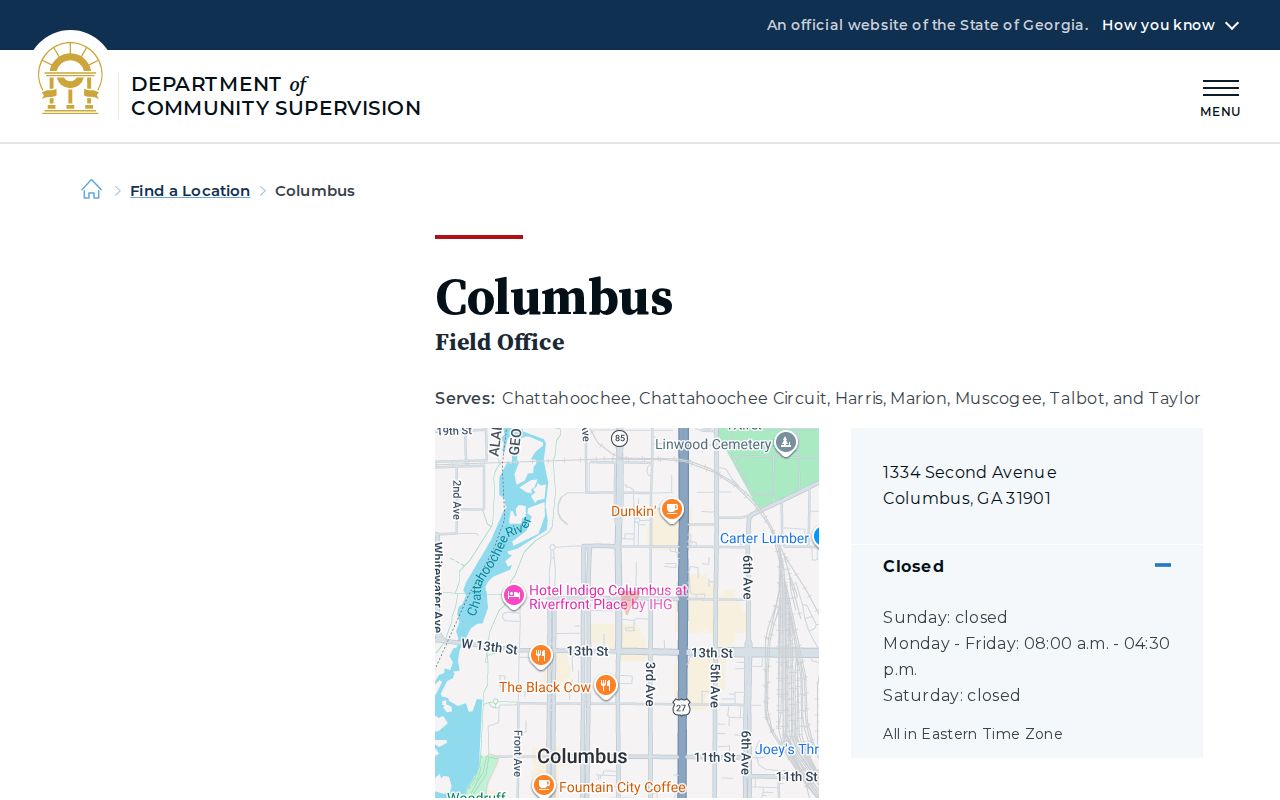
The listing connects a Muscogee release assigned to state supervision with the Chattahoochee Circuit office.
Muscogee Parole Review Records
Georgia does not publish a Muscogee County parole hearing calendar. The practical public timeline is individual. The Board's Tentative Parole Month information says a TPM is the month when final review is expected and, if appropriate, a parole release date may be set. It is not a promise. Conduct, program conditions, sentence rules, and later Board action can affect the result.
A granted and finalized parole can lead to release under DCS supervision. A denial or deferral leaves the person in custody pending later review or sentence expiration. A tentative date may also be delayed or rescinded. A max-out occurs when the prison term expires, and that person may leave without parole. Eligibility is governed mainly by O.C.G.A. § 42-9-45, subject to serious-offense, recidivist, life-sentence, and mandatory-minimum limits.
The Georgia parole process shows why review and actual release are distinct.
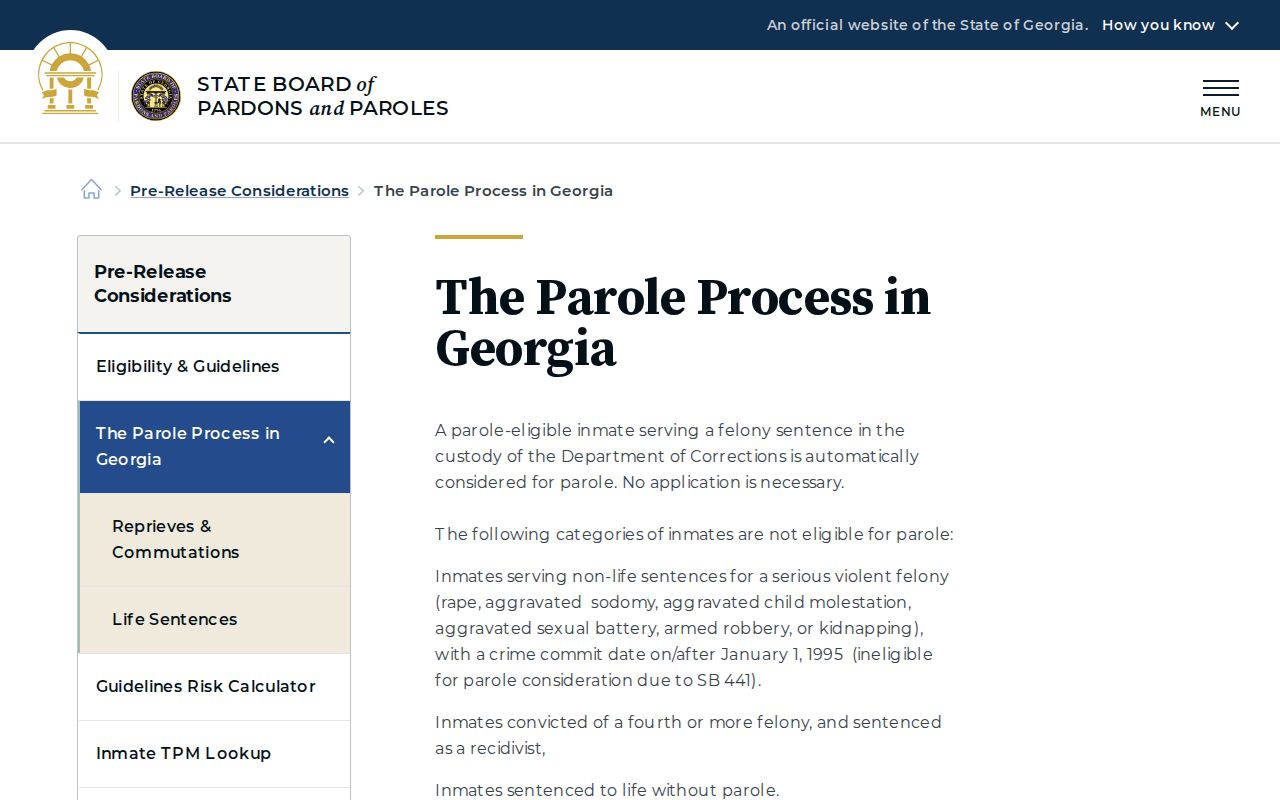
The state process applies to a GDC prisoner, while a Muscogee jail bond release remains a county court and jail matter.
Muscogee Supervision Violations
Conditions are rules attached to release or sentence. They can include reporting, approved travel, court-ordered payments, testing, treatment, or other terms in the case. Exact conditions are individual. A violation allegation does not explain custody by itself. DCS records, the court docket, any warrant entry, and a new jail booking must be read together.
An absconder is a supervised person alleged to have stopped reporting or left supervision without authorization. A warrant may follow, but those terms are not interchangeable. Smart Search includes cases, judgments, and warrants, with warrant-status and date filters. DCS addresses supervision. Jail Search may show a new arrest. Each source proves a different part of the sequence.
- Parole
- Conditional release before a prison term reaches its maximum end.
- Probation
- Court-ordered community supervision.
- Absconder
- A person alleged to have stopped required supervision contact.
- Discharge
- Formal completion or termination of custody or supervision.
Muscogee Release Reentry Programs
Muscogee has a notable local reentry link before release. The sheriff's Bureaus page describes Fatherhood Dorm, Veterans Dorm, faith-based recovery, GED, literacy, substance-abuse, and reentry programs in the jail. Priority is generally given to people expected to return to the local community. Participation does not prove parole or probation was granted. It shows preparation that may occur while the person remains confined.
Columbus Transitional Center is another distinct stage. It provides GDC residential reentry before discharge, so residence there is not final community release. A later GDC inactive status, parole record, or DCS assignment supplies the release proof. Program participation is not a fixed release date or guaranteed outcome.
Muscogee Supervision Discharge
Supervision ends through a formal discharge, sentence completion, court order, or other action by the authority controlling the case. Leaving Muscogee County Jail does not end probation. Leaving a GDC prison does not end parole. The parolee database, DCS record, court docket, and GDC status should be checked for the term involved.
An old court or corrections record may remain public after active supervision ends. Record restriction may limit a public result without changing the historical event. When the end date matters, seek confirmation from the originating court, Board, GDC, or DCS custodian.
Note: A jail release date, parole start date, and supervision discharge date are separate events recorded by different agencies.
Muscogee Supervision Record Sources
No single office owns every part of a Muscogee County parole or probation history. The State Board owns parole decisions and provides the public parolee database. GDC owns the state incarceration record and its parole or pardon status link. DCS owns many community-supervision records. The sentencing court owns the judgment, probation sentence, and later orders. A new jail booking belongs to the sheriff and eCourt jail route. Send a request to the source that created the disputed fact.
For a person convicted in Muscogee and sent to GDC, search conviction county and then match the GDC ID, offense, and facility. If the person is still confined, a TPM may describe a future review month. If released on parole, Parolee Search is the more direct public confirmation. If probation was ordered without state prison, the judgment is the starting point. DCS can identify the local field office when public records do not show the assignment.
DCS publishes an adult felony probation overview describing its role.
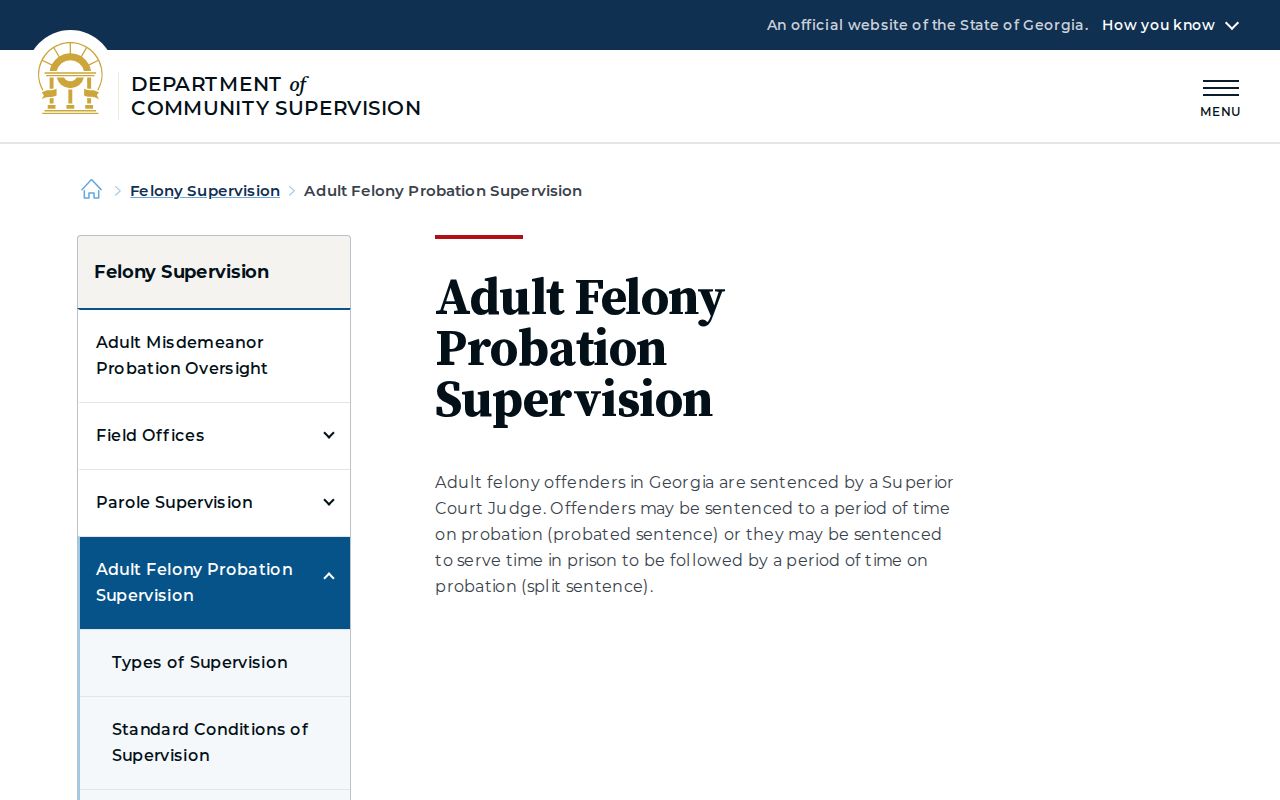
The agency overview distinguishes court-ordered probation from a jail release entry and from the Board's parole decision.
Muscogee Release Versus Supervision
County release and state supervision should be read as separate layers. Jail Search may confirm a booking ended. The court case may show bond, time served, or a probation sentence. GDC may show that the person entered or left state custody. The Board may show parole, while DCS may hold the community assignment. One record does not cancel the need for the others when a full timeline matters.
VINELink can provide a custody-change notice for the Muscogee jail, but it is not a complete supervision history. It does not replace a certified disposition, state sentence calculation, or discharge record. Likewise, a person absent from the parolee search may be on probation, may have completed supervision, may be searched under different identifying data, or may require confirmation from the agency. Match the legal path before deciding which absence has meaning.
When contacting an agency, give the person's full name, date of birth if known, GDC or case number, and the county of conviction. Ask a narrow question: whether parole or probation is active, which office holds the record, or whether a formal discharge was entered. A focused request is easier to route and reduces confusion with a person who has a similar name. Verify the answer against the court or Board record that created the term.
DCS open-records questions can be directed to 404-463-2072, while the department's statewide primary number is 678-783-4337. Those contacts help route a supervision-record request when the Columbus field office is not the custodian. State Board questions about parole decisions remain separate from DCS supervision questions, and the sentencing court remains the source for a probation judgment.