
Muscogee County Released Inmates
Release means a person left one custody entry. It does not always mean the person went home. A Muscogee County Jail booking can end through bond, time served, dismissal, court order, medical action, or transfer. State prison release can mean parole or discharge at the end of a term. Another agency may take custody under a warrant, federal hold, or immigration detainer.
The agency that held the person keeps the key record. The sheriff and Muscogee eCourt systems cover the county jail. Georgia Department of Corrections records cover state sentences. The State Board of Pardons and Paroles and DCS cover parole and community supervision. BOP and ICE are separate federal systems. A released person often drops from a live roster, so the search must follow the custody path.
Muscogee County Release Types
The exit reason determines what record proves release. A bond release is tied to the jail entry and court case. Time served and dismissal should appear through the disposition or order. A transfer closes the local stay but starts or continues another custody record.
| Type | Meaning | Next source |
|---|---|---|
| Bond | Release under court-set terms | Jail Search and eCourt |
| Time served or dismissal | Court action ends confinement | Court judgment and sheriff record |
| GDC transfer | State custody continues | GDC active search |
| Parole or discharge | State prison custody ends | GDC, Board, and DCS |
| Federal or ICE hold | Another system may take custody | BOP or ICE locator |
Muscogee County Release Record Fields
A county release record connects identity, booking, charges, and exit. The public portal may not show every field, so the court case and sheriff response may be needed to explain why the person left.
| Field | What it shows |
|---|---|
| Name and booking number | Links the person to the jail stay |
| Booking date and agency | When and by whom custody began |
| Charges, case, and court | Legal matter tied to custody |
| Bond status | Whether a bond route applied |
| Release date and time | When the booking ended |
| Release reason or destination | Bond, order, sentence end, or transfer when recorded |
State records differ. A GDC inactive record may include identity, photo, offense, conviction county, status, and release or maximum-date information. A parole record concerns supervision, not the county booking.
Request Muscogee Release Records
Use the sheriff open-records route when Jail Search and court records do not give the release time, reason, or destination. Include enough detail to identify one booking.
- Give the full name and any date of birth, booking number, case number, or date range known.
- Ask for the booking and release entry, release date and time, release type, charges, and transfer destination if recorded.
- Email mcsoorr@columbusga.org or send the request to Records Custodian, Muscogee County Sheriff's Office, 100 10th Street, Columbus, GA 31902.
- Review any estimate and clarify the scope if retrieval or redaction would raise cost.
Georgia law generally requires access or a timetable within three business days for readily available records. O.C.G.A. § 50-18-71 permits authorized search, retrieval, redaction, and production costs, with letter or legal copies capped at ten cents per page. Muscogee does not publish a fixed online retention period for released jail entries.
Muscogee Release Record Laws
The Georgia Open Records Act governs access and lawful costs, but it does not make every field public. Sealed, restricted, juvenile, medical, security-sensitive, and other protected material may be withheld or redacted. Record restriction under O.C.G.A. § 35-3-37 affects public access to qualifying criminal-history material. It does not rewrite the historical custody event in every agency system.
Online visibility is not legal retention. No official Muscogee source reviewed promises that a released jail entry stays public for a set number of hours or days. Archived proof should be sought from the custodian.
Find Muscogee County Released Inmates
The sheriff's Inmate Search leads to the eCourt portal. Muscogee does not publish a verified rolling 24-hour or 72-hour release feed. Search a named person across the systems that can show custody, court cause, transfer, and later supervision.
- Use Jail Search for the party's jail record.
- Use Smart Search by name, record, booking, or SO number for cases, judgments, and warrants.
- Check Georgia VINELink for a custody-status change.
- Search GDC active records for a transfer and inactive records for state release.
- Use the parolee database or DCS if supervision follows.
- Use BOP or ICE only when the case entered those systems.
- Request the sheriff record when public results do not resolve the exit.
GDC Muscogee Release Search
GDC Find an Offender covers Georgia state records, not ordinary pretrial jail custody. Search by name, physical description, GDC ID, case number, sentence status, offense, or conviction county. Select inactive offenders for someone no longer incarcerated, or both active and inactive when transfer status is uncertain. “Released In The Past 15 Days” is a state filter, not a county feed.
The official query form shows those choices.
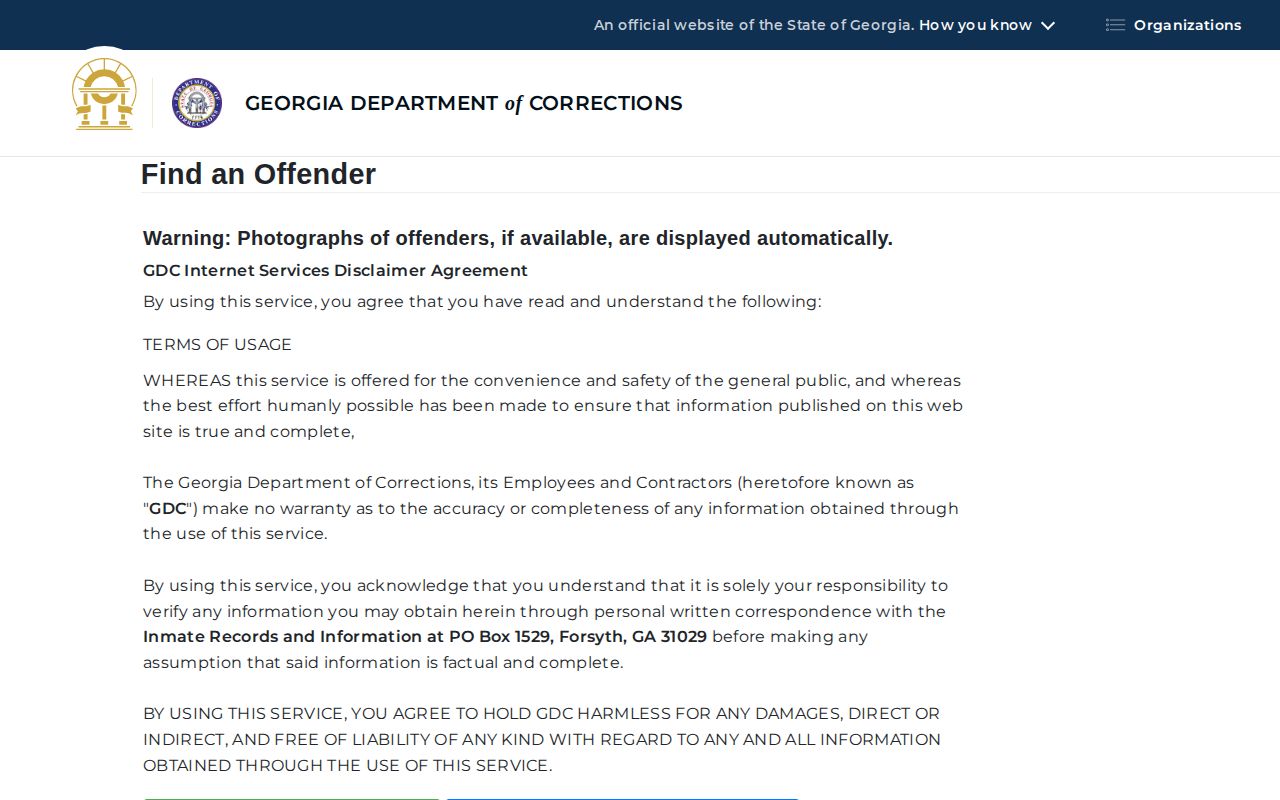
The scope and sentence filters help separate a transfer into GDC from a completed state release.
Muscogee Bond Release Confirmation
Jail Search is a party jail-record tool, not a county-published recent-release archive. It requires JavaScript and cookies, and Muscogee states no public update cadence or retention window. Use VINE, same-day court entries, and the records custodian when the live result is absent. Bond confirmation is also local: the sheriff FAQ directs callers to the jail at 706-653-4258, while eCourt may show case, payment, and hearing details.
Muscogee Release Court Checks
Court interplay is central in Muscogee because one eCourt portal provides Jail Search and Smart Search. Jail Search is the party jail-record route. Smart Search can examine cases, judgments, and warrants by name or record number, then narrow results with court location, file dates, case status, booking number, SO number, and warrant fields. Search Hearings adds another view of scheduled court activity.
A custody result alone rarely explains why release occurred. The court file may show bond, a dismissal, time served, a probation sentence, a recalled warrant, or a transfer order. It can also show that a new warrant remains even after one booking ends. Match the person and case before drawing a conclusion. The Clerk's portal page is the official route.
The Muscogee eCourt landing page displays these record channels.
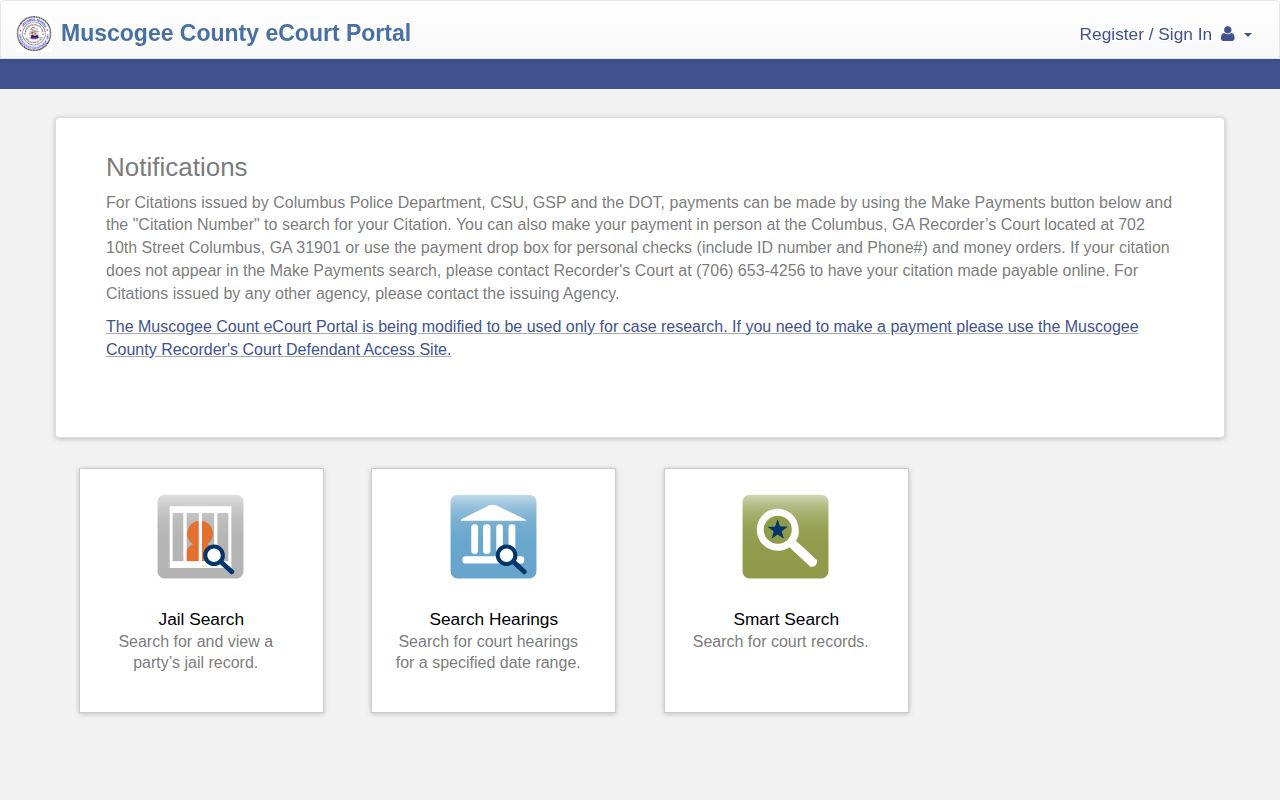
The portal keeps the live jail record and the longer-lived court explanation close, but each answers a different question.
Muscogee Release Reentry Programs
The sheriff provides unusually detailed information about programs offered before release. Its Bureaus page lists Fatherhood Dorm, Veterans Dorm, faith-based recovery, GED, literacy, substance-abuse, and reentry programming. Priority is generally given to people expected to return to the local community. These facts can help families identify what preparation may occur in custody, but they do not promise admission or a specific result.
Program participation is not proof of release. A person remains in jail until the custody record changes. Columbus Transitional Center also provides reentry services while residents remain in a GDC residential setting. Final community release must still be confirmed through GDC, the Parole Board, or DCS as applicable.
Parole and Probation After Release
A person may leave confinement while a sentence continues in the community. Parole follows conditional state-prison release and is decided by the State Board of Pardons and Paroles. Probation is imposed by a court. DCS supervises many people assigned to Muscogee through its Columbus Field Office. Use the Board's parolee database, GDC status, court judgment, and the Muscogee parole and probation page to verify the right term.
Release Notifications and Federal Releases
The sheriff's Muscogee VINE page supports email, text, and phone alerts when jail custody changes. A phone registration uses a four-digit PIN. VINE is a fast signal, but the jail and court records explain the reason. Federal releases belong in the BOP Inmate Locator, which covers federal inmates from 1982 forward. ICE ODLS is a current detention locator, so absence there does not prove a Muscogee release.
Released vs Still in Custody: Where to Look
Use current-custody tools for people still held and durable records for those who have left.
| Situation | Source |
|---|---|
| Current county jail stay | Muscogee Jail Search and VINE |
| Past county release | Sheriff release record and eCourt disposition |
| Active or released state prisoner | GDC active/inactive search |
| Parole or probation | Board, court, and DCS |
| Federal custody or release | BOP locator |
| Current immigration detention | ICE ODLS |
Muscogee County Release Facilities
Columbus contains several legally distinct custody settings. Muscogee County Jail releases are verified through county and court records. Muscogee County Correctional Institution holds county and state offenders, so GDC may control the release record. Rutledge State Prison is a state prison. Columbus Transitional Center remains a GDC residential setting until final parole or discharge. The court portal, GDC, Parole Board, DCS, VINE, BOP, and ICE entries in the facility map are systems, not interchangeable jails.
This local mix is why the facility name matters. The current county jail opened beside the old complex in December 2002, while GDC separately lists the correctional institution, Rutledge, and transitional center. A move between them can look like release from one record while custody continues.
Verify Muscogee Release Results
Verification means matching more than a name. Start with date of birth or age, then compare booking, case, SO, GDC, or register numbers when available. Check the holding facility and the agency that made the arrest or controlled the sentence. A release date should fit the court event or sentence record. A transfer destination should lead to an active record in the receiving system. These links reduce the risk of confusing two people or mistaking a closed booking for community release.
When systems disagree, favor the record closest to the event but confirm it with the legal source. VINE may signal that custody changed before the court docket updates. The jail entry may show an exit before GDC posts a transfer. A court judgment can explain time served or probation even if the person no longer appears in Jail Search. Written sheriff or GDC verification is the fallback when a public interface is incomplete.
Keep the purpose narrow: confirming release, reconnecting, receiving a custody alert, following a court matter, or obtaining a lawful record. Public results can be incomplete, and restricted records may not appear. Do not infer the reason for an absence without checking the custodian. A clear request names the person, date range, booking or case, facility, and exact release fields sought.
Muscogee Release Destination Checks
A destination check answers the question left open by “released.” If the sheriff record says bond, compare the case docket and bond order. The sheriff FAQ directs bond-amount questions to the Muscogee County Jail, while eCourt can show related case, payment, and hearing information. If the record says time served, look for the sentence or judgment. If it says transfer or agency pickup, search the receiving system rather than treating the exit as a return home.
GDC is the first transfer check for a Georgia sentence. Search active offenders when a person has just disappeared from the county jail, then use inactive records for someone believed to have completed state custody. A GDC individual result may include a photo, offense, conviction county, location, status, release information, and a parole-status link, though fields vary. GDC asks users to verify through Inmate Records and Information at PO Box 1529, Forsyth, GA 31029.
For federal custody, BOP explains that a past release date with no listed facility means the person is no longer in BOP custody, although another system or federal supervision may follow. ICE ODLS covers people currently in ICE custody and some people held by CBP beyond 48 hours. It is not a release archive. Absence from either system cannot, by itself, prove what happened to a Muscogee jail booking.
Muscogee records also require attention to names and portal limits. Smart Search accepts names in last, first, middle, suffix format and can search by record number. Its expanded criteria include nickname, business name, similar-sounding names, phone, FBI number, SO number, and booking number. Court filters include Jail, Municipal Court, Probate Court, Recorder's Court, State Court, and Superior Court. Warrant criteria can narrow type, status, and issue dates. These fields are useful when the jail result has vanished or a common name produces several matches.
Searches should still be checked against the underlying document. Portal data can lag, JavaScript or cookie settings can block Jail Search, and public access may omit protected material. A court case can outlast confinement by years. That makes it useful for explaining the release, but it should not be read as proof of current custody without a current jail, VINE, GDC, BOP, or ICE check. The best result is a timeline in which identity, booking, court action, exit, destination, and supervision agree.
Muscogee Release Request Timing
A records request works best when it identifies one custody event. The sheriff's public route accepts email at mcsoorr@columbusga.org and mail or in-person delivery to the Records Custodian at 100 10th Street, Columbus, Georgia 31902. Include the person's full name, an approximate booking or release date, and any booking, SO, or case number already found. Ask for the booking and release entry, release date and time, release reason, charges, bond status if releasable, and destination when another agency took custody. A narrow request helps the custodian locate the correct record without searching unrelated bookings.
Georgia's Open Records Act generally requires access or a timetable within three business days when records are readily available. That period is a response rule, not a promise that every request will be completed in three days. Records that require retrieval, legal review, or redaction may take longer. O.C.G.A. § 50-18-71 permits authorized search, retrieval, redaction, production, and copy charges. Letter- and legal-size copies are capped at ten cents per page, but the Muscogee sheriff page does not publish a separate fixed fee for every release request. Review an estimate before broadening the request.
Public access can also be limited by the record itself. Juvenile information, medical details, protected victim data, sealed material, and other exempt content may be withheld or redacted. Georgia record restriction may reduce public visibility of qualifying criminal-history information, but it does not make every agency erase the historical booking or court action. If Jail Search no longer returns the person, request the archived release entry instead of assuming that the record was destroyed. Muscogee publishes no fixed online retention window for former jail entries.